

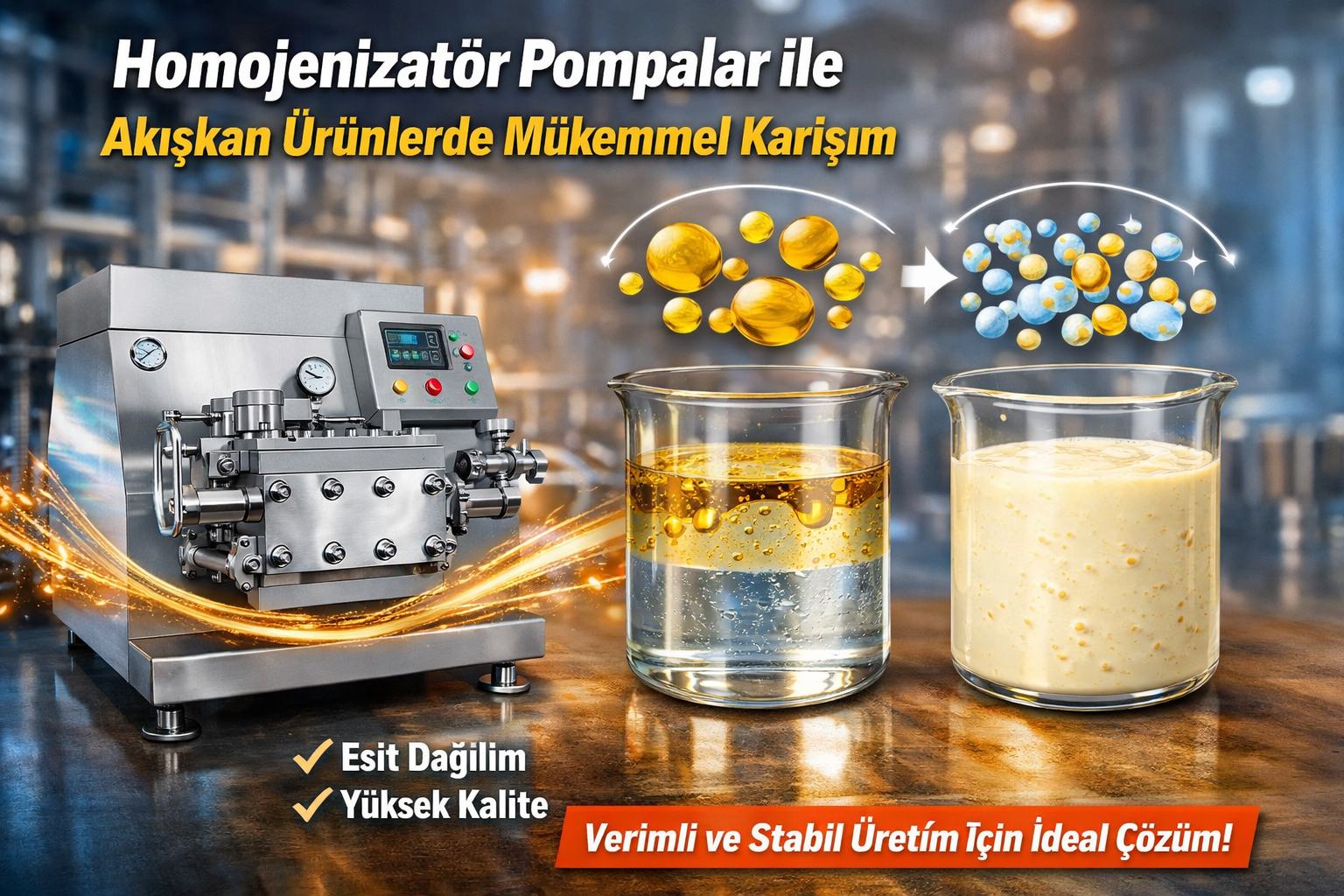
Thanks to these systems, particles are distributed homogeneously; thus, phase separation is delayed and shelf life is extended. In addition, the production line operates more controllably and efficiently. In this content, we examine the working principle of homogenization technology, the advantages it provides, and the areas in which it is used step by step.
What is a Homogenizer Pump and How Does It Work?
A homogenizer pump reduces particles in liquid or semi-fluid products to very small sizes, ensuring even distribution throughout the mixture. The system balances and stabilizes the product structure through high-pressure, directed flow.
During operation, the product passes through a narrow channel at high speed. The shear force, turbulence, and cavitation effects generated during this passage actively break down the particles. As a result, the mixture acquires a smoother, brighter, and more consistent structure.
Classical mixers only bring components together. In contrast, homogenization systems improve the physical properties of the product. Therefore, they hold an important position in industrial production.
The Importance of Homogenization in Fluid Products
When a homogenous structure is not achieved in fluid products, quality problems quickly arise. For example, oil and water-based phases separate, consistency becomes inconsistent, and the taste and texture of the product vary. As a natural consequence, shelf life is shortened.
In contrast, correct homogenization application creates the same structure at every point in the product. It also reduces the risk of sedimentation during filling and storage processes. Thus, the manufacturer offers consistent quality, and the end user encounters a reliable product.
Advantages of Industrial Homogenization Systems
Homogenization technology not only improves mixture quality but also enhances production processes.
Consistency in Product Quality
Similar results are obtained in every production batch. This feature provides a significant advantage for mass production facilities.
Longer Shelf Life
Reduced particle size increases product stability. Thus, phase separation occurs later.
Time and Energy Efficiency
Results are obtained in a shorter time compared to classical mixing methods. As a result, the need for reprocessing is reduced.
Hygienic Production Structure
The closed-system design limits the product’s contact with external factors. This is particularly important in food and pharmaceutical production.
Applications of Homogenization Systems
Homogenization applications play an active role in many sectors involving fluid products.
Food Industry
Milk and dairy products, sauces, mayonnaise, ketchup, and beverages fall into this category. In these products, a homogeneous structure directly affects both taste and visual quality.
Cosmetics and Personal Care
Smooth texture is paramount in creams, lotions, and hair care products. Therefore, a stable structure is of great importance.
Chemical and Pharmaceutical Industry
Emulsions, suspensions, and liquids containing active ingredients are prominent in this field. A homogeneous structure plays a critical role in product safety.
How to Choose the Right Homogenization Equipment?
Not every production line requires the same equipment. Therefore, certain criteria must be considered during the selection process.
First, the viscosity of the product is evaluated. Denser products require higher pressure. Production capacity and the targeted flow rate also affect equipment selection.
In addition, the materials used must comply with hygiene standards. Stainless steel housings are preferred in the food and pharmaceutical industries.
Hommak stands out as a reliable option in this field with its solutions developed for different sectors.
The Difference Between Homogenization and Mixing
Mixers bring components together; however, they do not reduce particle size. Therefore, phase separation becomes inevitable in the long run.
Homogenization systems, on the other hand, reduce particles to micron level and stabilize the mixture. This difference is particularly noticeable in high-quality products.
The Scientific Basis of Homogenization
The homogenization process is based on fluid mechanics. Shear forces generated under high pressure increase the surface area of particles. This strengthens the interaction between phases and improves product stability.
Consequently, for those seeking more technical information, the principles of homogenization are discussed in detail in academic and industrial resources.