
In industrial production, homogeneous mixing is one of the most critical components of product quality. Regardless of whether it’s food, cosmetics, chemistry, pharmaceuticals, or biotechnology, the even distribution of the mixture in every production line directly affects both the physical and chemical stability of the product. Therefore, the selection of industrial mixers plays a decisive role in the efficiency of production processes.
So, what methods should be used to truly achieve homogeneous mixtures in production? What are the advantages offered by industrial mixers? Here’s a detailed examination…
The Importance of Industrial Mixers: Why Homogeneity is Essential?
A homogeneous mixture means that the components are evenly distributed in the formulation.
Insufficient mixing can lead to the following problems:
- Inconsistencies in product consistency and texture
- Uneven distribution of active ingredients
- Color differences or sedimentation
- Shorter shelf life
- Disruption of product standardization
Industrial mixers eliminate these problems and keep processes under complete control thanks to their high shear force, torque, and speed settings.
Types of Industrial Mixers Used for Homogeneous Mixing in Production
Different mixers are used according to different production needs. The most common types of industrial mixers are:
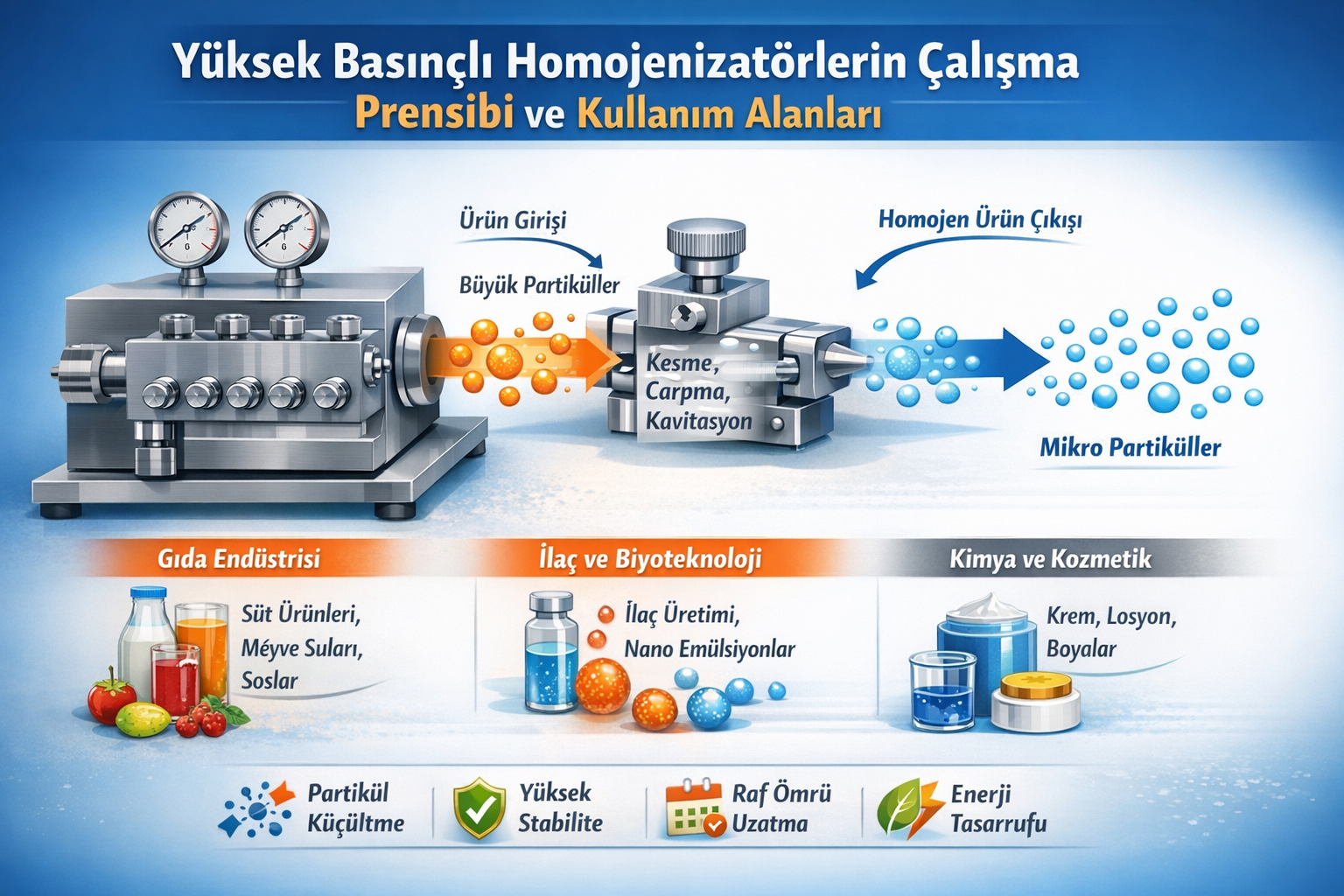
Homogenizer Mixers: Reduce particles with high shearing effect, distributing them completely within the product.
Ideal for dairy products, sauces, creams, lotions, and chemical formulas.
High-Shear Mixers: Provide fast and powerful mixing thanks to their blade rotor-stator structure. Prevents clumping in powder-liquid mixtures.
Vacuum Mixers: Used in the cosmetics and chemical industries to prevent foaming. The vacuum environment minimizes unwanted air bubbles.
In-Tank Industrial Mixers: Used in high-volume production; suitable for continuous operation.
Inline Mixers: Increase process efficiency by continuously mixing products passing through the line. Homogenization and dispersion processes can be performed simultaneously.
5 Essential Ways to Achieve Homogeneous Mixing
Choosing the Right Mixer: No single mixer is suitable for every process. The product’s viscosity, particle size, component type, and production volume must be considered.
Ensuring Sufficient Shear Force: The shear force applied by the mixer plays a critical role in achieving homogeneous mixing. High-shear mixers and homogenizers can break down particles to the micron level.
Controlled Mixing Speed: Excessive speed can cause foaming or overheating. Low speed, on the other hand, leads to incomplete mixing of components. Gradual speed control ensures ideal distribution.
Heat Management: Some products exhibit changes in viscosity or stability during mixing. Process control should be implemented with heating or cooling jacketed tanks.
Determining the Correct Dosing Order: Rapid addition of powders to liquids can cause clumping. In emulsions, the order of oil-water phase addition directly determines product quality.
Advantages of Using Industrial Mixers in Production
- Standard quality among products
- High efficiency in a short time
- Optimum production cost with low energy consumption
- Stable formulations with complete dissolution of active ingredients
- Elimination of human error
- Repeatable results in large-scale production
Industrial mixers provide manufacturers with a significant competitive advantage by increasing both quality and operational efficiency.
Industrial Mixers are Used in Which Sectors?
- Food: Milk, yogurt, sauces, beverages, chocolate, mayonnaise
- Cosmetics: Creams, shampoos, serums
- Chemistry: Paints, detergents, resins
- Pharmaceuticals: Syrups, suspensions, gel formulations
- Biotechnology: Cell culture media, nutrient mixtures
Every process requiring homogeneous mixing needs industrial mixers.
The Right Mixer is Essential for Efficient and Homogeneous Mixtures
Industrial mixers are one of the most critical pieces of equipment determining quality in production. With the right mixer selection, appropriate mixing parameters, and process control, it is possible to obtain completely homogeneous, stable, and high-quality products.
If your production line requires a process involving homogenization, mixing, emulsification, or dispersion, choosing the right industrial mixer will both reduce your costs and elevate your product quality to the highest level.
HOMMAK develops customized systems for the needs of various sectors, offering solutions focused on high efficiency and durability in industrial mixer technologies. Its wide product range, from high-shear mixers to vacuum mixing units, provides manufacturers with both homogeneous and repeatable results. Mixer designs developed in HOMMAK’s R&D center offer advantages such as energy savings, long service life, and minimal maintenance requirements, while their flexible structure, adaptable to products of varying viscosities, significantly improves the production quality of businesses.