

Modern laboratories, however, are turning to advanced homogenization technologies for reproducible results. Hommak supports research processes by developing solutions that meet this need.
Laboratory Homogenization Systems and Working Principle
Laboratory homogenization systems stabilize the structure of liquid and semi-solid mixtures. Therefore, these systems reduce particle size and equalize distribution. This allows the analysis process to proceed more reliably.
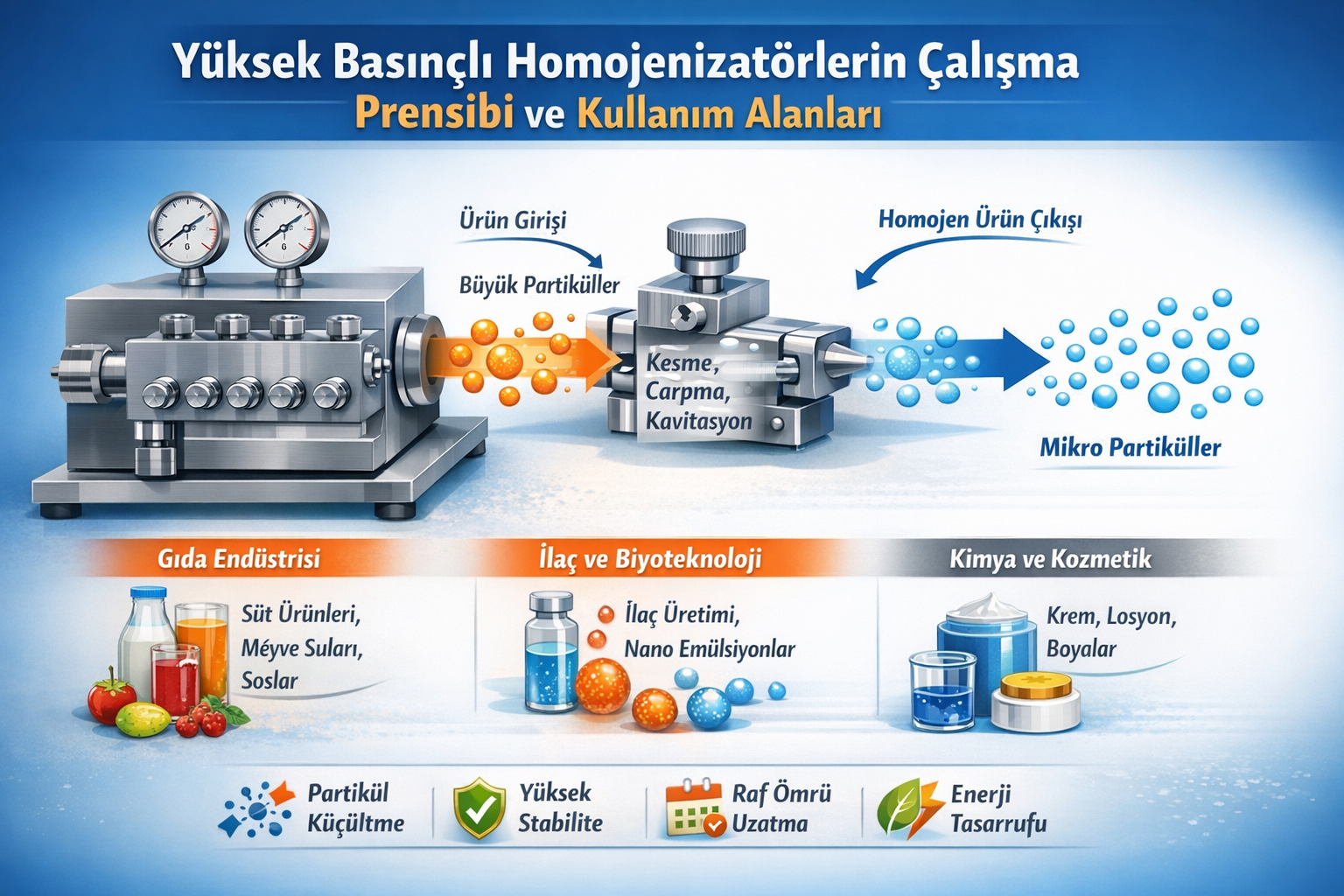
Furthermore, high pressure and mechanical shear forces work together. This effect produces consistent results even in micro-scale samples.
The Importance of Homogeneous Distribution in Small-Scale Experiments
Even the slightest imbalance in small-volume experiments affects the result. Therefore, homogeneous distribution improves experimental quality. This requirement becomes even more pronounced, especially in biotechnology and pharmaceutical R&D studies.
However, measurement deviations occur if the appropriate system is not used. Correct homogenizer pump technology eliminates this risk.
Experimental and Pilot Scale Homogenizer Applications
These systems play an active role in various sectors:
- Biotechnology: Cell lysis and protein isolation
- Pharmaceutical R&D: Emulsion and suspension development
- Food Research: Sauce and dairy product trials
- Cosmetics: Cream and lotion stabilization
- Chemistry: Micro and nanoparticle studies
Therefore, device selection depends on the application area.
How Does Homogenizer Pump Technology Work?
Homogenizer pump systems pass liquid through a narrow passage under controlled pressure. This process creates a strong shear force, separating particles into uniform sizes.
As a result, the mixture becomes more stable, and product quality is significantly improved.
Criteria for Selecting the Right Homogenization Device
To select the right device, the following points should be considered:
- Sample volume
- Target particle size
- Pressure capacity
- Ease of cleaning and maintenance
- Experimental repeatability
Once these criteria are clear, the selection process is accelerated. At the same time, long-term efficiency is ensured.
Advantages of High-Pressure Homogenization Systems
High-pressure systems offer superior control in small-scale experiments. These systems create a narrow particle distribution.
They also maintain parameter compatibility during scaling up. This feature facilitates pre-production testing.
Hommak Laboratory and Pilot Scale Solutions
Hommak develops specialized homogenization systems for laboratory and pilot scale applications. Features include a compact design, user-friendly control, and a robust pump structure.
Hygiene, Cleanliness, and Safety Advantages
Hygiene is of paramount importance in laboratory environments. Hommak systems feature easily demountable parts. This design significantly shortens cleaning time.
Furthermore, stainless steel surfaces reduce the risk of contamination. Safety valves maintain pressure balance.