
1. The Pursuit of Excellence in Production
In modern industrial production, the success of a formulation depends not only on the quality of the ingredients, but also on how the physical architecture of these ingredients is constructed. The biggest challenge for manufacturers is ensuring stability throughout the shelf life and maintaining batch-to-batch consistency. The answer to the question, “Why do some products quickly decompose on the shelves while others retain their freshness for months?” lies in the engineering precision offered by high-pressure homogenization technology. Unlike traditional mixing methods such as mixers, a high-pressure homogenizer is not just a “mixing” equipment; it is an advanced process equipment that directly determines the microstructure and stability of the product. The most critical difference here is determining the most accurate and optimized working pressure for each product.
2. Maximum Bioavailability: Efficacy at the Nanometer Scale
In the pharmaceutical and dietary supplement industry, the value of a product is measured by how much of it can be absorbed by the body (bioavailability). High-pressure homogenizers are one of the most effective methods of the “Top-Down Nanotechnology” approach. By reducing the particle size to the nanometric range, it dramatically increases the surface area. The scientific basis behind this dimensional transformation is explained by the Noyes-Whitney equation. According to this equation, as the particle size decreases, the surface area increases, and consequently, the dissolution rate of the active substance increases logarithmically. For BCS Class II (low solubility, high permeability) drugs, this technology is not an option, but a molecular prerequisite. For R&D teams, this means dosage optimization and higher clinical efficacy with less raw material.
3. Flawless Physical Stability: The End of Ostwald Maturation
The success of a nanoemulsion is measured by its ability to resist gravity. When the particle size drops to a critical level, Brownian motion dominates the force of gravity, stopping sedimentation. However, the main enemy of manufacturers is the Ostwald Ripening effect, where small droplets gradually transform into larger droplets, causing phase separation. High-pressure homogenizers make the droplet size so smooth and uniform that the thermodynamic equilibrium of the system is maintained and Ostwald Ripening is minimized. Strategically, this extends the commercial life of the product, reduces waste rates, and guarantees the product’s durability in the global supply chain, thus supporting the brand’s commercial sustainability.
4. Chemical-Free Cell Disruption: Pure Efficiency in Biotechnology
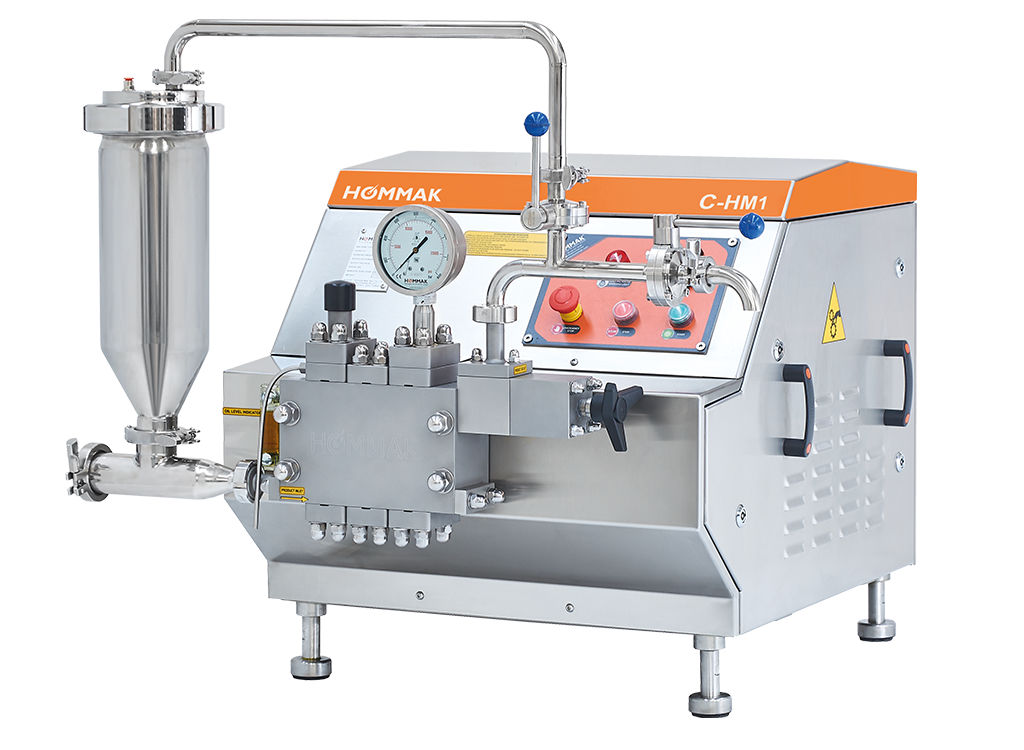
In biotechnological production, obtaining enzymes, proteins, and recombinant molecules depends on the efficient destruction of the cell wall (yeast, bacteria, algae). High-pressure technology is considered the first step in downstream processes, which are the most critical stage in the production of biotechnological products. “High-pressure homogenizers are very effective and highly efficient for cell lysis processes. The quality of the resulting products is at a very high level.” A high-pressure homogenizer does not require toxic solvents or expensive chemicals to extract intracellular material; it only uses physical forces. This “clean” lysis process radically reduces purification costs while increasing the purity of biopharmaceuticals, providing a great advantage in regulatory processes.
5. Sensory Excellence: Smooth Texture and Mouthfeel
Consumer loyalty is built on the sensory experience the formulation creates in the mouth.
In liquid and semi-liquid supplement products, high-pressure homogenization ensures homogeneous distribution of active
components and carrier phase at the sub-micron scale, eliminating the risk of precipitation and phase separation; thus creating a smooth, balanced and repeatable drinking profile in every
batch — which directly means a premium product.
This micronized structure not only provides a smooth texture; it also plays a critical role in masking metallic or bitter tastes in the formulation (e.g., proteinaceous aromas in collagen drinks). For brands, this is the shortest way to create a “premium” product perception and meet the consumer’s quality expectations with every sip.
6. Confidence in Scale-up: PDI Control and Consistency
Transferring the laboratory success of a formulation to industrial production is a risky process. The greatest strategic advantage of a high-pressure homogenizer is that it provides precise control over the Polydispersity Index (PDI) of the product. A low PDI value indicates how narrow and homogeneous the particle distribution is. Regulatory authorities such as the FDA and EMA require consistency of the PDI value for the approval process, especially in injectable nano-pharmaceuticals. The use of a homogenizer makes it possible to maintain the characteristics of the laboratory-scale prototype in full-scale production, even at pressures up to 20,000 psi. This repeatability is a decisive force in commercial risk management and time-to-market.
7. High Purity and Safety: Eliminating the Risk of Contamination
In traditional methods, the impact of the liquid on the valves under high pressure could lead to the mixing (erosion) of microscopic metal particles into the product. The danger this situation could create was remembered in 2010 when 11 batches of clevidipine butyrate injection emulsion were recalled by the FDA in the USA due to the risk of metal residue. In our modern homogenization design, the interaction zone is designed to be completely dead-leg free and using tungsten material with high wear resistance. The flow geometry is designed to provide controlled and continuous flow on all surfaces in contact with the product. It is fully compatible with CIP (Clean-in-Place) and SIP (Sterilization-in-Place) processes. This structure minimizes the risk of contamination, especially in injectable pharmaceutical products, while supporting process safety and brand reliability on a global scale.

8. Full Qualification and Assurance: GMP Compliance
There is no room for error in pharmaceutical and biotechnology production. Therefore, we offer our homogenizer solutions not just as equipment, but as a process system that is verified, documented, and ready for inspection in accordance with GMP (Good Manufacturing Practices) requirements, from design to commissioning.
Our quality and compliance approach is based on a holistic qualification structure that includes the following verification steps:
IQ / OQ / PQ / DQ protocols
All validation documentation for design (DQ), installation (IQ), operation (OQ), and performance (PQ) qualifications is provided completely. Thanks to this structure, internal and external audits carried out in your facility are accelerated, and licensing and technical acceptance processes are significantly facilitated and secured.
FAT – Factory Acceptance Test
The system undergoes comprehensive performance and safety tests at our factory before shipment. Critical process parameters and safety functions are verified with customer approval, ensuring that the machine is fully compliant when deployed on site. SAT – Site Acceptance Test
After the equipment is installed at your facility, it is verified on-site under your actual production infrastructure and process conditions. This officially records that the system is working in full compliance with your line and operational requirements. This ensures that the homogenizer is a reliable part of your production line not only technically but also in terms of regulation, inspection and sustainable quality.
Conclusion
High-pressure homogenizers have transformed process design from merely an operation of bringing phases together into a molecular engineering discipline controlled at the nanometer scale. These seven strategic transformations, from increased bioavailability to flawless stability, from chemical-free cell lysis to operational safety, define the production standards of tomorrow today. Adapting this technology to modern production lines not only improves product quality but also ensures regulatory compliance and commercial sustainability.