CIP Systems
The hygiene of your production lines is the foundation of your product quality and your brand reputation. A CIP system is a closed-loop solution that cleans and disinfects production equipment automatically, without disassembly. As HOMMAK, we manufacture turnkey CIP installations engineered specifically for the food, dairy, beverage, pharmaceutical and cosmetics sectors, bringing your entire cleaning cycle together under a single integrated solution.
20+ Years of Experience
We have been active in the industry since 2004
Manufacturer’s Guarantee
We guarantee full customization and competitive pricing
Short Lead Times
Our in-house production capacity keeps lead times to a minimum
The Invisible Guarantee of Hygienic Production
In modern production facilities, manual cleaning means both lost time and a higher risk of contamination. A Clean-in-Place (CIP) system eliminates this problem by circulating alkaline and acid solutions, rinse water and sanitizers through the lines at programmed temperatures, pressures and durations.
HOMMAK CIP units ensure that every product-contact surface is cleaned uniformly, continuously maintaining the level of hygiene required by HACCP, FDA and EHEDG standards.
Repeatable Cleaning Performance Through Automation
The most critical factor defining the value of a CIP unit is its ability to deliver the same result on every cycle. With PLC-based control systems, touchscreen HMI panels and conductivity, temperature and flow sensors, cleaning cycles run under full validation.
As a result, operator error is reduced to almost zero; water, chemical and energy consumption become measurable; and production downtime is significantly shortened.
Turnkey CIP Solutions Engineered by HOMMAK
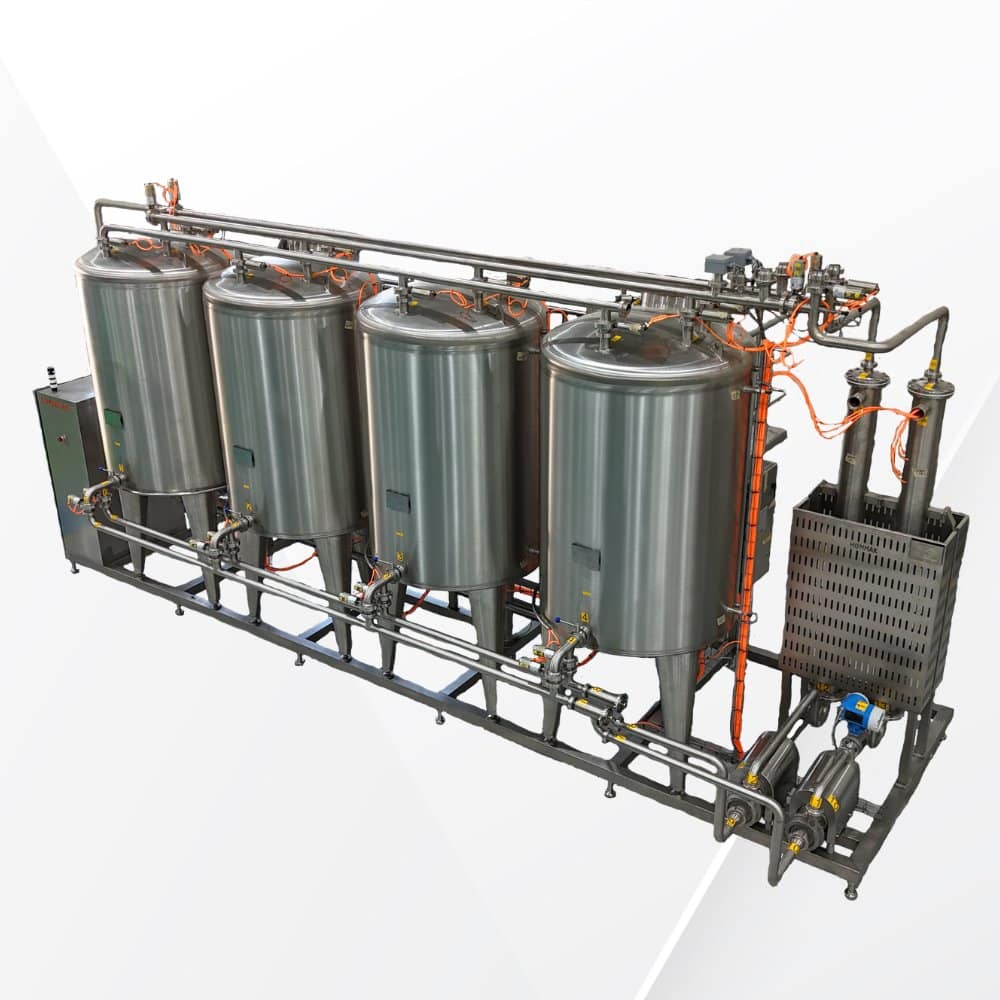
HOMMAK designs and manufactures custom-engineered CIP units tailored to each facility’s line geometry, product groups and capacity. From stainless steel (AISI 304/316L) tank fabrication and hygienic valve and pump integration to the entire on-site commissioning process, everything is managed by a single point of contact.
For a preliminary study, capacity calculation or quotation for your project, please use the contact form or request a quote.
Contact Form
What Is a CIP Unit and How Does It Work?
A CIP unit is an automated system that cleans equipment such as tanks, pipes, heat exchangers, homogenizers and filling lines without requiring disassembly, within a closed loop. Clean-in-Place technology was first developed in the dairy industry and has today become the standard across all process industries where hygiene is critical.
A typical CIP cycle consists of five main stages. The pre-rinse removes product residues; an alkaline phase (typically 1–2% NaOH at 70–85 °C) then dissolves fat and protein residues. After an intermediate rinse, an acid phase (0.5–1% HNO₃ at 60–70 °C) removes mineral deposits and milk stone. A final rinse, followed by disinfection where required, completes the cycle. The entire cycle is parameterized fully automatically according to the product and the type of soil.
Core Components of a CIP Installation
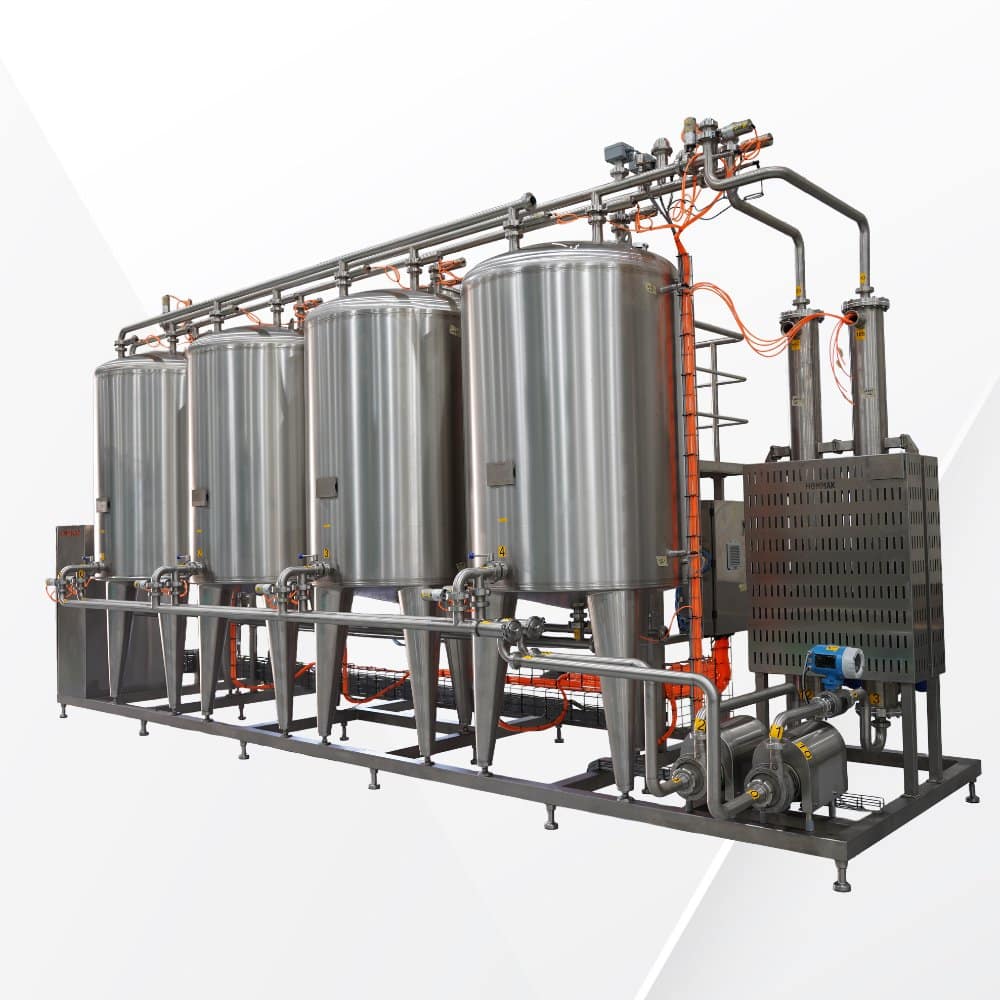
A high-performance CIP installation relies on the precise engineering of equipment that works in harmony. The following main components are included as standard in CIP units manufactured by HOMMAK:
- Solution tanks: Insulated AISI 304/316L stainless steel tanks, generally designed separately for alkaline, acid, fresh water and hot water.
- Feed pumps: High-flow centrifugal pumps with stainless steel bodies and leak-proof mechanical seal systems.
- Plate heat exchanger: A unit that provides precise control of solution temperature, offering rapid heating and efficient energy recovery.
- Hygienic valves and actuators: Mix-proof (double-body) type valves, compatible with automatic control and free of dead volume.
- PLC and HMI control panel: A control architecture supporting recipe-based cycle management, alarm tracking, production reporting and remote monitoring.
- Sensors: Conductivity, temperature, flow and pressure sensors providing the data set required for cycle validation.
The harmonious operation of these components directly affects all operating costs, from chemical consumption to energy efficiency.
In Which Industries Are CIP Units Used?
CIP installations are preferred across all liquid-process industries where product safety and hygiene standards carry legal obligations:
- Dairy and dairy products: Raw milk reception lines, pasteurizers, yogurt and cheese tanks, ayran and ice cream lines.
- Food and beverage: Fruit juice, alcoholic and non-alcoholic beverage production, sauces, liquid egg and syrup lines.
- Pharmaceuticals: Tank and piping systems in contact with active ingredients in GMP-compliant production facilities.
- Cosmetics: Cream, lotion, shampoo and liquid soap manufacturing lines.
- Chemicals and biotechnology: Fermentation reactors, bioreactors and precision filling systems.
Because residue limit (MAC) values and approval processes differ for each industry, designing the CIP unit with the correct parameters directly determines product compliance.
What Is the Difference Between CIP and SIP?
CIP (Clean-in-Place) and SIP (Sterilize-in-Place) systems serve different purposes, even though they are often used together in the same facility. CIP is focused on cleaning and reduces residues and microbial load to an acceptable level. SIP, on the other hand, is an additional step applied after CIP that provides absolute sterilization, typically using steam at 121 °C.
In the dairy and beverage industries, CIP alone is usually sufficient; however, in applications requiring a sterile environment—such as pharmaceuticals, biotechnology and aseptic filling—a CIP + SIP combination is mandatory. HOMMAK offers integrated designs that meet both needs.
Advantages of Choosing a HOMMAK CIP Unit
HOMMAK Makina is an engineering company that has specialized in the manufacture of high-pressure homogenizers, piston pumps and hygienic process equipment since 2004. This accumulated expertise translates into the following concrete advantages on the CIP side:
- Single-source engineering: Design, manufacturing, installation and commissioning are all handled by a single point of contact, so interface responsibility is never fragmented.
- Flexible capacity: Custom manufacturing across a range of capacities, from compact 500 liter/hour systems to multi-line industrial installations.
- Domestic production, fast service: Manufacturing at the İzmir Torbalı facility and an uninterrupted technical service network across Türkiye.
- Validation-friendly design: Data logging, traceability and reporting infrastructure required for GMP and HACCP audits.
- Low operating cost: Energy, water and chemical savings through heat recovery, solution reuse and optimized cycle times.
- CE-compliant, ISO 9001 certified production: Full compliance with international standards.
These factors set HOMMAK CIP units apart from the competition in terms of both investment cost and long-term efficiency.
Frequently Asked Questions
How much does a CIP unit cost?
CIP installation prices are determined by capacity, the number of tanks, the level of automation, material quality (AISI 304 or 316L) and any additional sterilization (SIP) requirement. HOMMAK provides a transparent, detailed quotation by carrying out a free preliminary study specific to your project.
How long does a CIP cycle take?
A standard full cycle takes an average of 45 to 90 minutes, depending on the type of product and the volume of the line. In optimized cycles, this time can be reduced to as little as 30 minutes.
Are CIP units only suitable for large facilities?
No. HOMMAK also manufactures single-tank compact CIP models for small and medium-sized producers. The investment scales in proportion to capacity.
Can a CIP unit be retrofitted to my existing production line?
Yes. By examining the piping, valve and tank infrastructure of your existing facility, retrofit solutions can be designed. This process may require the addition of hygienic valves and line modifications.
Which chemicals are used in a CIP unit?
The most commonly used are sodium hydroxide (NaOH)-based alkaline solutions, nitric acid (HNO₃)-based acid solutions, and peracetic acid- or chlorine-based sanitizers. Chemical selection is made according to the product type and the supplier preferred by the facility.
Contact Us Now
Contact our expert team today for tailored solutions for your projects.