Food & Beverage Homogenization Systems
In modern food and beverage production, flavor, texture, and shelf life are no longer left to chance. HOMMAK high-pressure homogenizers elevate your production quality across a wide range of products—from fruit juices to sauces, chocolate to baby food—by ensuring stable emulsions, fine particle sizes, and uniform distribution.
The Role of Homogenization in Food and Beverage Production
Homogenization is the cornerstone of product stability in food and beverage manufacturing. By reducing particle sizes under high pressure and evenly distributing fat globules, it prevents sedimentation, improves texture, and naturally extends product shelf life.
From pulp distribution in fruit juices to oil-in-water emulsions in mayonnaise, the goal remains the same: consistent quality, superior sensory experience, and efficient production. Correct homogenization is a critical step not only for quality but also for energy efficiency and raw material utilization.
Which Food and Beverage Products Benefit from Homogenization?
HOMMAK food and beverage homogenizers are successfully applied in a wide variety of industrial food products, including fruit juices, fruit concentrates, ketchup, mayonnaise, sauces, chocolate, soy milk, baby food, tomato paste, molasses, tahini, and more.
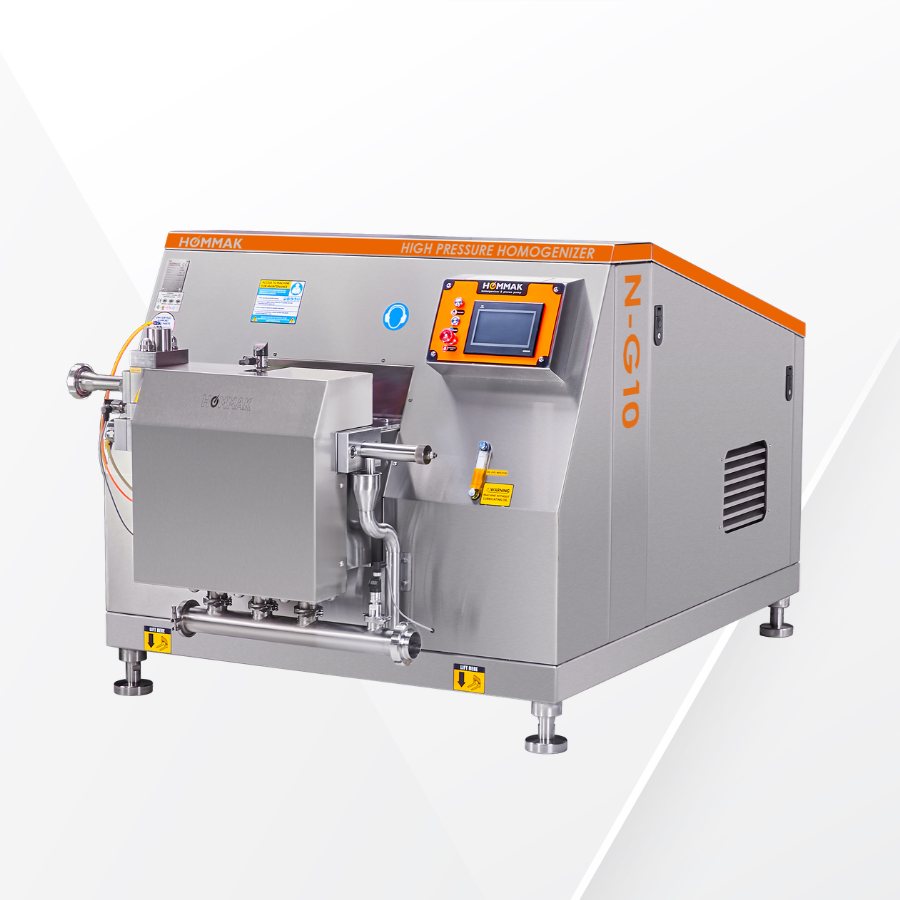
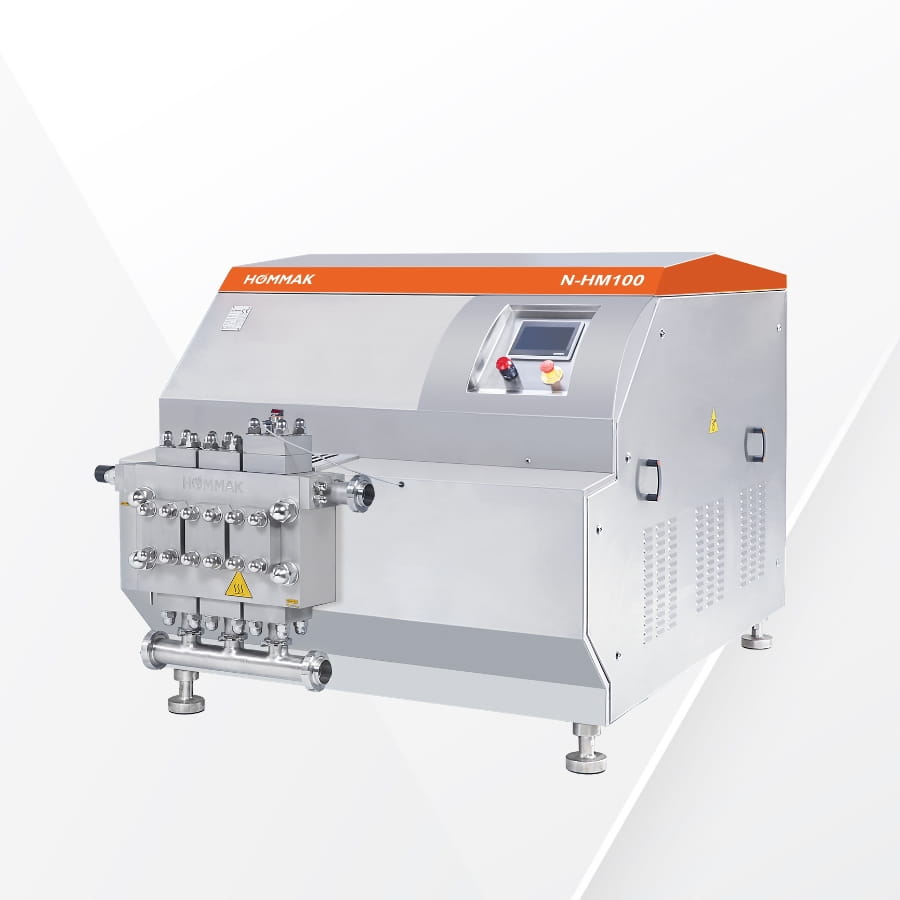
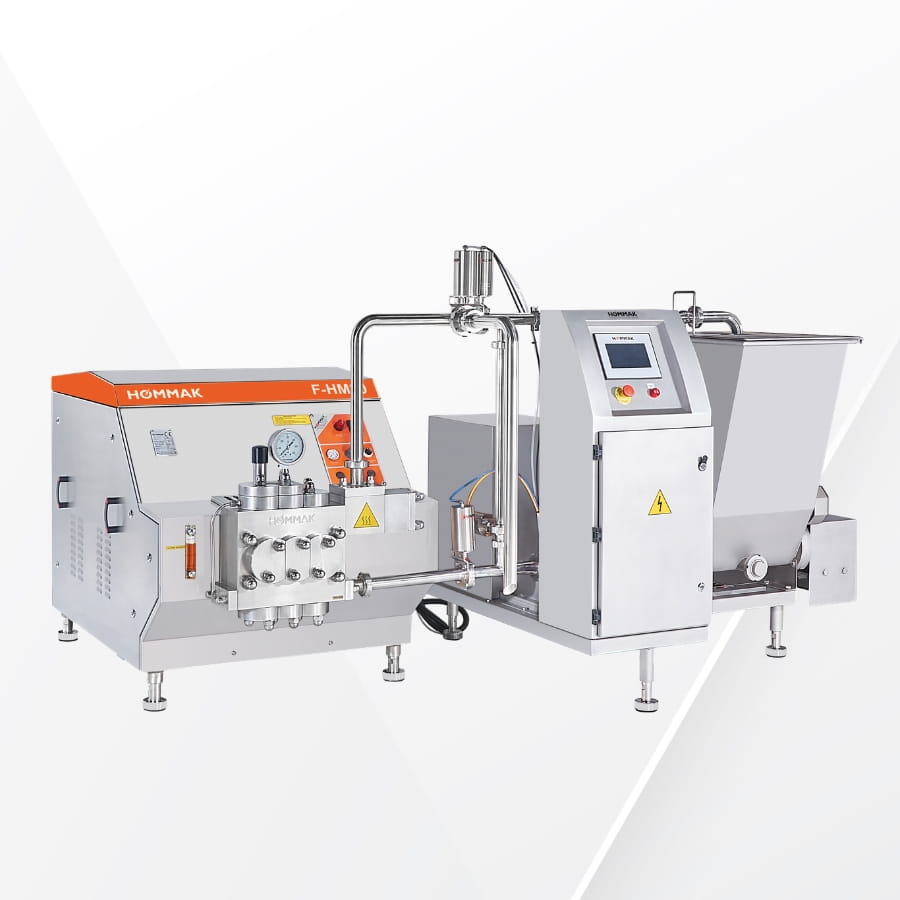
Since every product group possesses unique viscosity, particle structure, and hygiene requirements, HOMMAK offers flexible configurations tailored to every production scale with industrial, pilot-scale, and laboratory-type homogenizer options.
Let’s Determine the Right Solution for Your Production Line Together
Choosing the right homogenizer requires a combined evaluation of capacity, pressure rating, product viscosity, and hygiene standards. The Hommak engineering team provides customized technical analysis and solution proposals tailored to your needs.
Simply fill out the form for a quick quote or technical consultation.
Contact Form
What is High-Pressure Homogenization and How Does It Work?
High-pressure homogenization is the process of reducing particles to micron levels by passing a liquid or semi-liquid product through a narrow homogenization valve under pressures ranging from 100 to 1,500 bar. During this process, turbulence, cavitation, and shear forces work simultaneously to break down fat globules, evenly distribute solid particles, and prevent phase separation.
The result: a smoother, more stable food or beverage product with no sedimentation and a longer shelf life. Operating within a broad pressure range of 60 to 1,500 bar, HOMMAK homogenizers provide single-source solutions for both conventional food emulsions and advanced nano-emulsions, liposomes, and functional food applications.
Benefits of Homogenization in the Food and Beverage Sector
Homogenization delivers measurable quality and efficiency gains to your production line. Key benefits include:
• Naturally Extended Shelf Life: By preventing phase separation and stabilizing emulsions, the need for chemical additives is minimized.
• Consistent Texture and Mouthfeel: Particle sizes are standardized at the micron level, ensuring every batch meets the same sensory standards.
• Prevention of Sedimentation: Visual quality is preserved, particularly in fruit juices, sauces, and milk-based beverages.
• Enhanced Flavor and Color Intensity: Finer particles create a larger surface area, intensifying taste and color perception.
• Raw Material Savings: Less emulsifiers and stabilizers mean a cleaner label.
• Hygienic and CIP-Compliant Production: Food-grade stainless steel bodies and detachable blocks provide high hygiene standards and rapid cleaning.
Industrial Application Areas
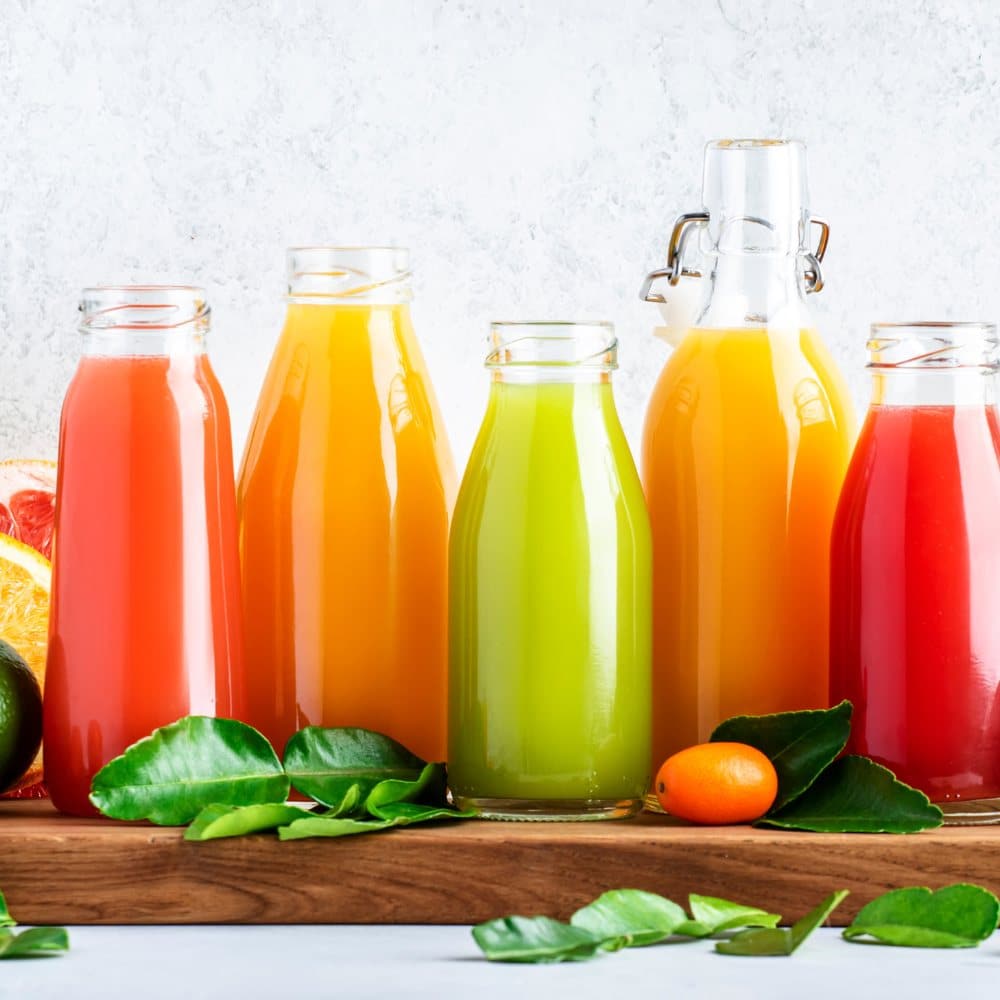
• Fruit Juices, Nectars, and Pulpy Beverages: The most common quality issue in fruit juices is the settling of pulp over time, causing phase separation. High-pressure homogenization solves this by reducing pulp particles to a uniform size to keep them suspended, improving mouthfeel and extending shelf life. It is critical for tomato juice, orange juice, sour cherry nectar, and mixed fruit/vegetable blends.
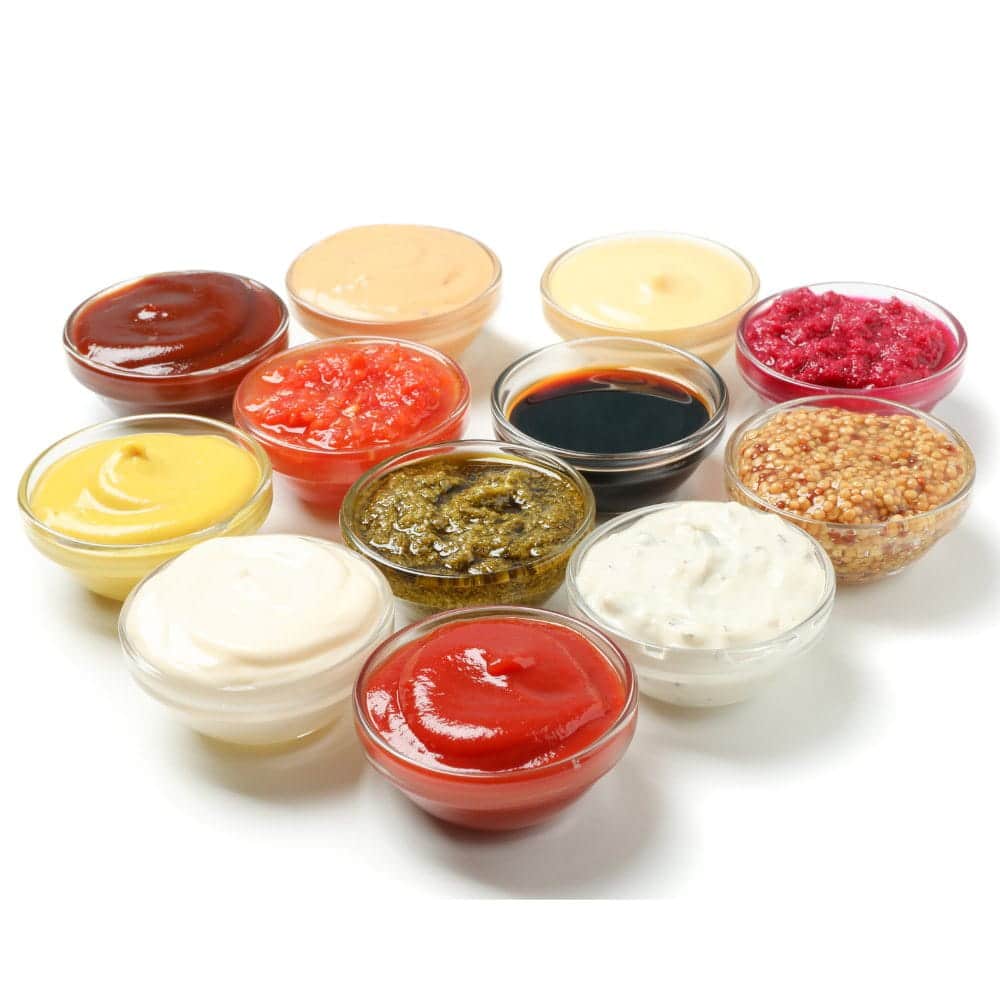
• Sauces, Ketchup, and Mayonnaise: Keeping oil and water phases in a stable emulsion is fundamental to producing mayonnaise, salad dressings, and ketchup. HOMMAK homogenizers ensure stable, continuous emulsions even in high-viscosity products, preventing oil separation, syneresis, and structural breakdown while maintaining absolute pressure stability for hot-fill lines.
• Soy Milk and Plant-Based Beverages: Even distribution of proteins, fats, and fiber particles is essential in plant-based milks such as soy, almond, and oat milk. Without homogenization, these products quickly separate and form sediments on shelves. HOMMAK homogenizers deliver a smooth, milk-like texture, opaque appearance, and long shelf life.
• Chocolate, Tahini, and Nut Butters: Particle refinement and uniform fat distribution are decisive in oil-based products with high solid content. Homogenization yields a glossy, silky texture in chocolate and a stable matrix that prevents oil separation in tahini and peanut/hazelnut butters.
• Baby Food and Sensitive Nutrition: Particle size directly impacts digestibility and nutrient absorption in baby foods, clinical nutrition formulations, and functional foods. HOMMAK’s high-pressure capability allows for advanced product development down to micron and nano-emulsion levels.
• Tomato Paste, Molasses, Honey, and Concentrates: For high-viscosity products with high Brix values, homogenization dictates consistency and visual quality. It enhances color intensity in tomato paste and minimizes crystallization tendencies in molasses.
Technical Advantages of HOMMAK Food and Beverage Homogenizers
• Broad Pressure Range (60–1,500 bar): A single platform capable of everything from classic emulsions to nano-emulsions.
• Versatile Capacities (100 L/h to 50,000 L/h): Scalable options from pilot plants to large industrial lines.
• Food-Grade Stainless Steel (AISI 316L): Wetted surfaces fully compliant with FDA and food regulations.
• CIP/SIP Compliant Design: Ensures zero hygiene loss with seamless clean-in-place and sterilization-in-place.
• Modular Homogenization Head: Single or two-stage valve configurations depending on product viscosity.
• Quiet and Vibration-Free Operation: Low energy consumption paired with extended maintenance intervals.
• Direct Engineering and Service Network: Rapid access to spare parts and technical support directly from the manufacturer.
How to Select the Right Food and Beverage Homogenizer?
Investing in a homogenizer is a long-term decision. Evaluating the following criteria guarantees zero-error selection:
1. Product Type and Viscosity Range: Is it a low-viscosity beverage or a high-solid sauce?
2. Required Pressure Level: While 150–250 bar suffices for classic homogenization, 1,000+ bar may be needed for nano-emulsions.
3. Hourly Production Capacity: Calculate both current throughput and 5-year growth projections.
4. Hygiene Standards: CIP/SIP capability is mandatory for baby food and functional nutrition.
5. Existing Line Integration: Compatibility with preceding/succeeding equipment (mixers, fillers, pasteurizers).
6. Service and Spare Parts Access: Critical for maintaining uninterrupted production.
Why Choose HOMMAK?
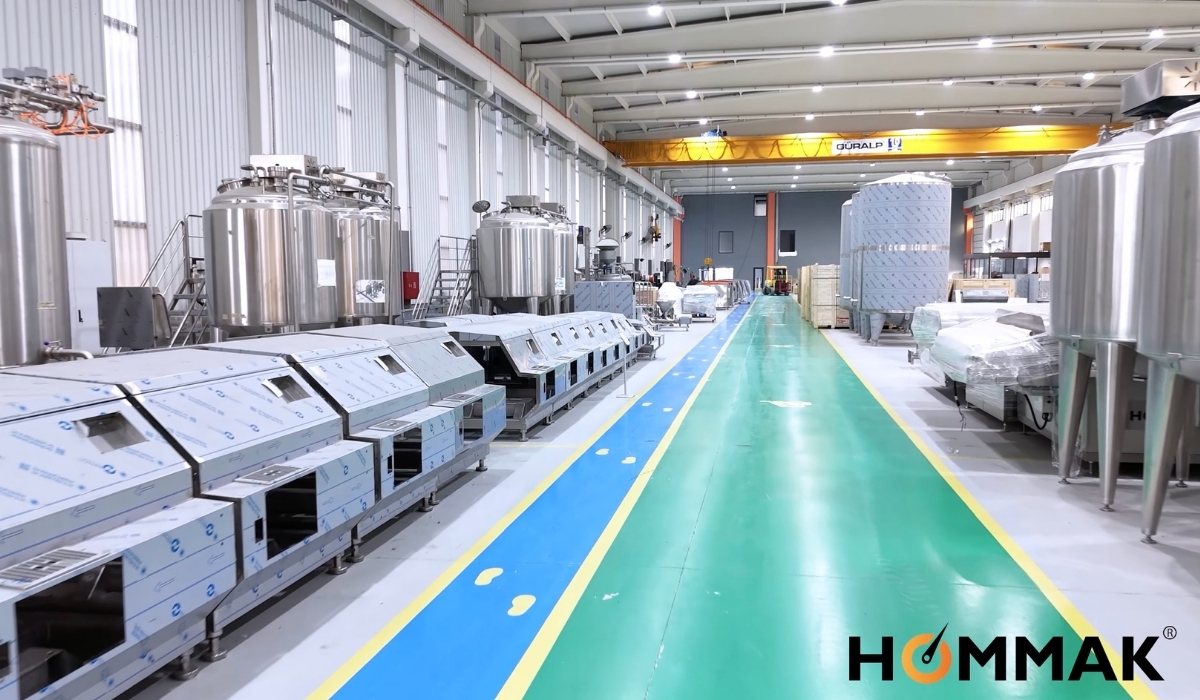
As Turkey’s pioneering domestic manufacturer of high-pressure homogenizers, HOMMAK exports to over 50 countries in the food and beverage industry. Each machine undergoes rigorous dual-stage quality control checks during hydraulic design, material selection, and assembly. Our engineering team manages the entire process under one roof—from project consulting and commissioning to training and after-sales service. Benefit from short delivery times and rapid spare parts availability through direct manufacturing.
Frequently Asked Questions (FAQ)
1. What does a homogenizer do in the food and beverage industry? Homogenization breaks down and evenly distributes particles and fat globules under high pressure. This results in a highly stable product with a uniform texture, extended shelf life, enhanced flavor/color perception, and zero sedimentation or phase separation.
2. Which food products require homogenization? Any food or beverage containing varying densities of particles or oil-water phases benefits measurably, including fruit juices, sauces, mayonnaise, ketchup, soy milk, baby food, chocolate, tahini, tomato paste, molasses, gelatin, and oils.
3. At what pressures do high-pressure homogenizers operate? HOMMAK systems operate from 60 to 1,500 bar. Traditional emulsions require 150–300 bar, while nano-emulsions and functional foods use 800–1,500 bar.
4. Does homogenization genuinely extend shelf life? Yes. Preventing phase separation significantly delays the physical degradation of the product during storage, reducing the need for chemical additives and aligning with the clean-label trend.
5. What is the difference between industrial and laboratory homogenizers? Laboratory models are built for R&D (10–100 L/h), pilot models for scaling up, and industrial models for continuous high-volume production. All share the same hydraulic principles, making scaling up seamless.6. What certifications do HOMMAK homogenizers hold? HOMMAK systems are CE and ISO 9001 certified, using AISI 316L stainless steel for wetted parts in full compliance with FDA and EHEDG hygienic design principles.
Contact Us Now
Contact our expert team today for tailored solutions for your projects.