
HOMMAK Microcut
In industrial production, reducing hard particles to a homogeneous, smooth and consistent texture is a critical engineering challenge that directly determines product quality. Insufficient size reduction leads to texture fluctuations, sedimentation, reduced shelf life and blockages on the filling line. Blade wear in conventional mixers, in turn, gradually translates into efficiency loss and high maintenance costs.
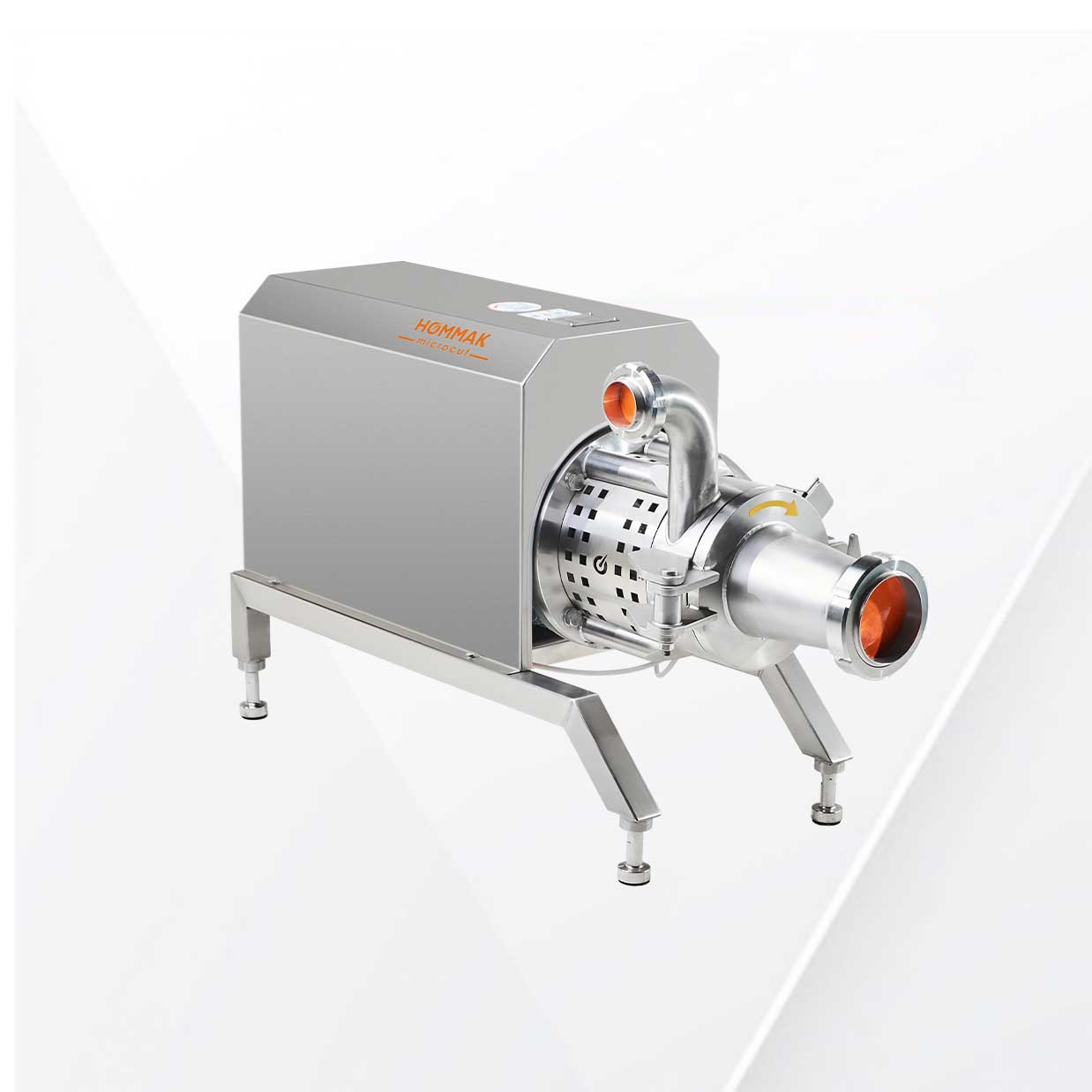
Hommak MicroCut is a rotor-stator mixer system engineered to solve these problems at the source, delivering high torque and high shear force. With its special tungsten-bladed geometry, 3,000 rpm rotational speed and high-durability material selection, it stands out as one of the most powerful particle size reduction systems in its class — delivering a homogeneous result in a single pass across a wide product range, from tahini and peanut butter to meat paste, sauces and liquid fertilizer.
20+ Years of Experience
We have been active in the industry since 2004
Manufacturer’s Guarantee
We guarantee full customization and competitive pricing
Short Lead Times
Our in-house production capacity keeps lead times to a minimum
How Does MicroCut Work?
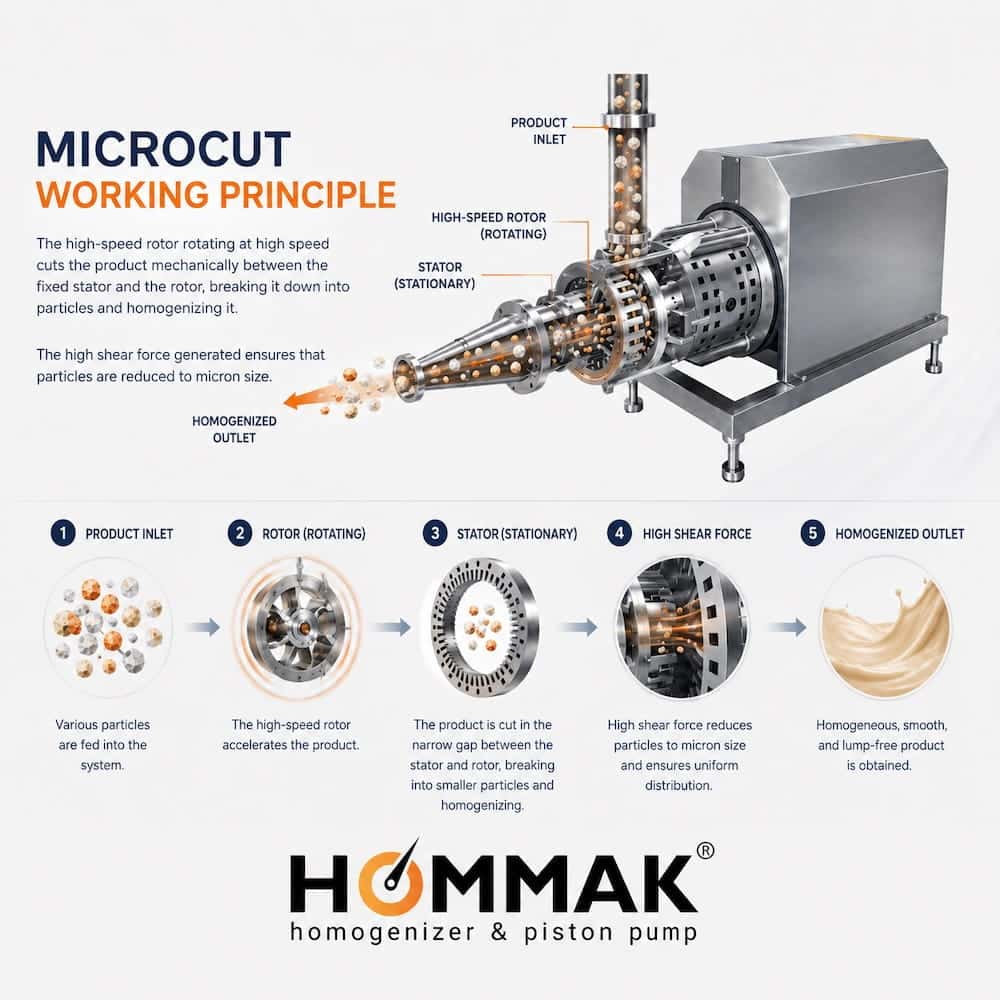
MicroCut differs fundamentally from conventional bladed mixers through its rotor–stator working principle. The rotor, rotating at high speed, mechanically cuts, breaks down and homogenizes the product in the narrow gap between itself and the fixed stator; the high shear force generated in this process reduces particles down to the micron scale.
The defining feature of this system is the tungsten blades used in the rotor and stator. Tungsten is one of the hardest metallic materials used in industry today and offers exceptional resistance to wear. As a result, MicroCut blades retain their first-day cutting performance for years — the annual or biennial blade replacement required in most competing systems is practically eliminated with MicroCut.
3,000 rpm high rotational speed breaks down even the hardest particles (nut shell fragments, fibrous meat tissue, crystallized fertilizer granules) in a short time; the product reaches a fluid, homogeneous and smooth structure.
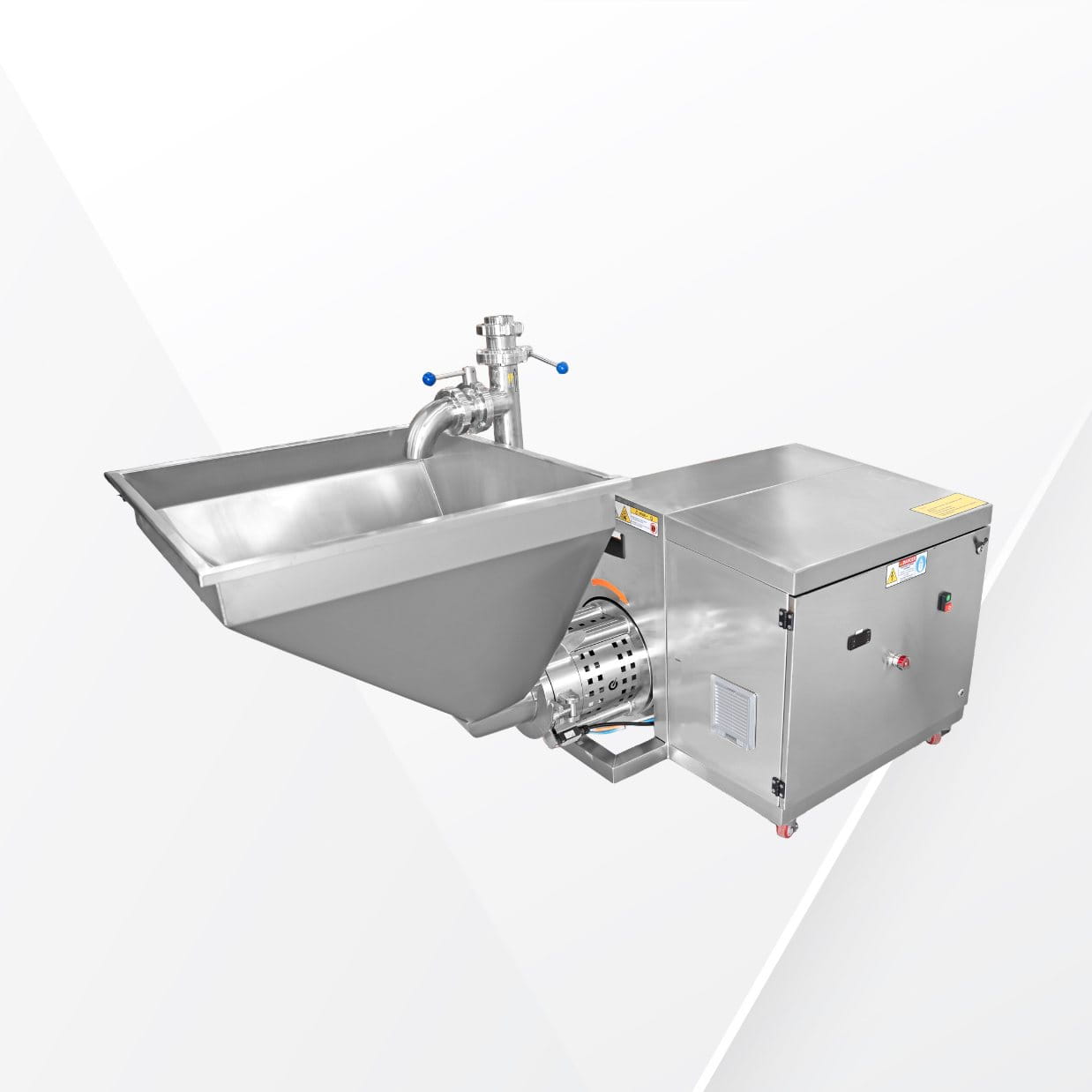
MicroCut Batch Model (Tank Type)
The batch model combines mixing and size-reduction operations in a single body. It is ideal for facilities running recipe-based, batch-type production. The product is pre-mixed inside the tank, then sent to the rotor-stator section for size reduction; once the process is complete, the homogeneous product is transferred directly to the filling line.
When is it preferred?
- Pilot production and formulation development facilities
- Recipe-based, small-to-medium volume production
- Products that require each batch to be quality-controlled independently
- High-viscosity products such as nut butters, tahini and hummus
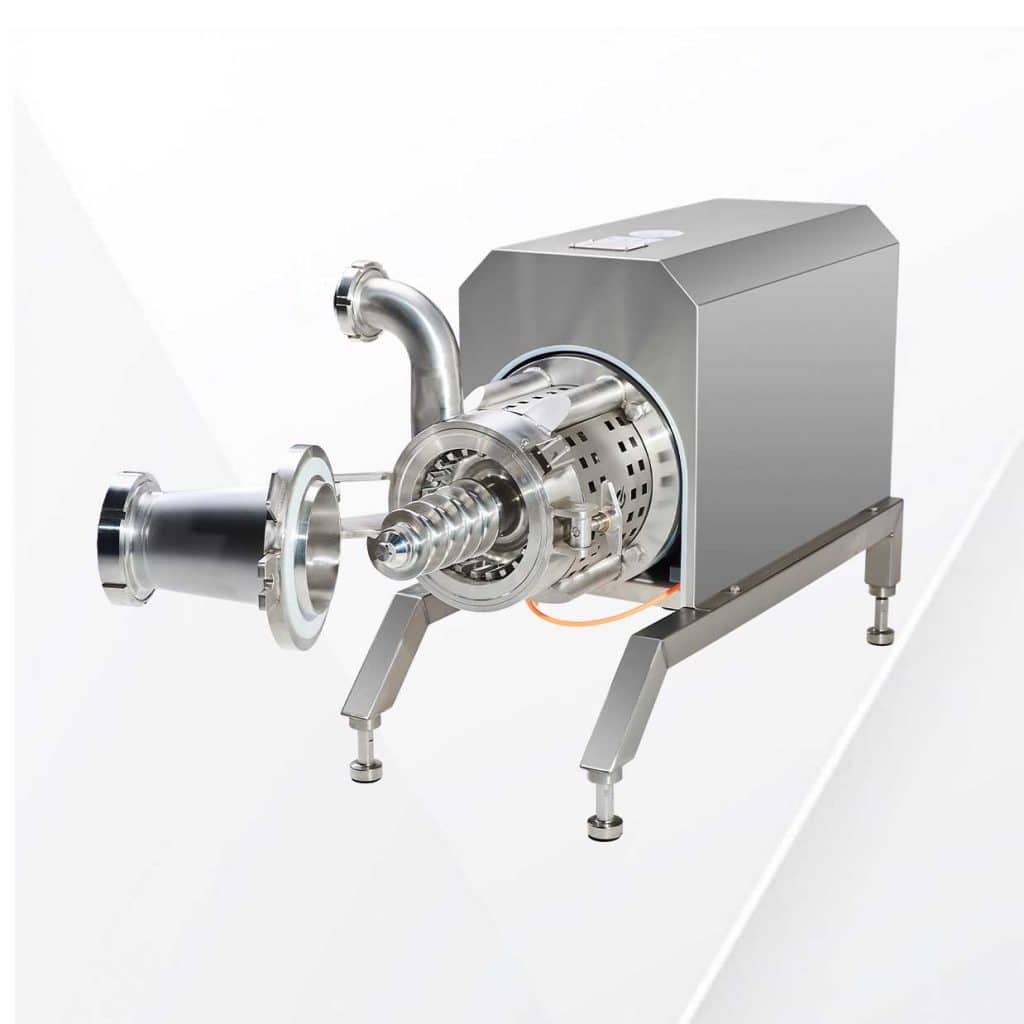
MicroCut Inline Model (Continuous Production)
The inline model provides uninterrupted processing by being integrated in-line into existing continuous production lines. Under pump pressure, the product enters the size-reduction section of the MicroCut in a single pass and is delivered in homogeneous form to the next station on the line. It creates no production downtime and keeps capacity stable.
When is it preferred?
- Industrial facilities operating 24/7
- High-volume, continuous-flow production lines
- Continuously processed products such as sauce, ketchup and mayonnaise
- Liquid fertilizer and suspension lines
Take Your Production to the Next Level with MicroCut Precision
With its high torque, tungsten blade technology and CIP/SIP-compatible hygienic design, MicroCut brings your particle reduction, homogenization and emulsification processes together on a single industrial platform. Whether you are a tahini producer, run a continuous sauce line or formulate liquid fertilizer — the Hommak technical team will design the most suitable MicroCut configuration for your line together with you.
Contact us to learn more about HOMMAK MicroCut.
Contact Form
MicroCut Models — Adapting to Your Production Line
MicroCut is offered in two different configurations depending on your production line type. Both versions are designed around the principles of maximum efficiency, minimum maintenance and long service life.
MicroCut Batch Model (Tank Type)
The batch model combines mixing and size-reduction operations in a single body. It is ideal for facilities running recipe-based, batch-type production. The product is pre-mixed inside the tank, then sent to the rotor-stator section for size reduction; once the process is complete, the homogeneous product is transferred directly to the filling line.
When is it preferred?
- Recipe-based, small-to-medium volume production
- Products that require each batch to be quality-controlled independently
- High-viscosity products such as nut butters, tahini and hummus
- Pilot production and formulation development facilities
MicroCut Inline Model (Continuous Production)
The inline model provides uninterrupted processing by being integrated in-line into existing continuous production lines. Under pump pressure, the product enters the size-reduction section of the MicroCut in a single pass and is delivered in homogeneous form to the next station on the line. It creates no production downtime and keeps capacity stable.
When is it preferred?
- High-volume, continuous-flow production lines
- Continuously processed products such as sauce, ketchup and mayonnaise
- Liquid fertilizer and suspension lines
- Industrial facilities operating 24/7
Batch vs. Inline Comparison Table
| Criterion | Batch Model | Inline Model |
|---|---|---|
| Production type | Batch | Continuous |
| Recipe flexibility | High | Medium |
| Hourly capacity | Depends on tank volume | Fixed and high |
| Line integration | Standalone unit | In-line on existing line |
| Ideal viscosity | High (tahini, pastes) | Medium-high (sauce, suspension) |
| CIP/SIP compatibility | ✓ | ✓ |
| Use case | Pilot / medium volume | High volume, continuous process |
Practical rule: If your production volume is variable and recipe-based, the Batch MicroCut is the right choice; if you run a fixed-volume continuous line, the Inline MicroCut is. In some facilities, both models are positioned together so that R&D/pilot and series-production needs are met from a single supplier.
MicroCut Application Areas
MicroCut delivers high texture consistency and excellent texture control in all kinds of liquid and semi-liquid products containing solid particles. Its broad application range makes the machine a standard solution in the food, chemical, cosmetics and agriculture sectors.
Food and Beverage Sector
- Nut butters: tahini, peanut butter, hazelnut butter, almond butter
- Ready meals: hummus, purées, vegetable mixes, fruit preparations
- Meat products: meat paste and emulsion preparation for sausage, salami, sucuk and kavurma
- Sauces and dressings: ketchup, mayonnaise, mustard, barbecue sauce, salad dressings
- Dairy products: fruit yogurt base preparation, cocoa suspensions, milk-dessert additives
Chemical and Agriculture Industry
- Liquid fertilizer production: homogenization of large-particle suspensions
- Pesticides and agrochemicals: in dispersion and emulsion processes
- Personal care and disinfectants: cream and emulsion-based formulations
- Cosmetics: particle homogenization in creams, gels and spreadable formulations
For detailed application consulting and sample testing, you can reach Hommak via the contact form.
6 Critical Features That Set MicroCut Apart from Other Mixers
- Tungsten-Bladed Rotor-Stator — Tungsten, one of the hardest metallic materials in industry, reduces wear to nearly zero and ensures long-lasting cutting efficiency.
- 3,000 rpm High Speed — With a rotational speed above that of conventional mixers, it breaks down even the hardest particles in a short time.
- High Torque Power — It delivers steady performance without straining the motor, even with high-viscosity products (tahini, meat paste, thick sauce).
- Dual Batch and Inline Configuration — It answers both batch and continuous production needs with the same technology.
- CIP/SIP-Compatible Hygienic Design — On-site cleaning and sterilization without production downtime; full compliance with food safety procedures.
- Food-Grade Stainless Steel Construction — A durable structure with high corrosion resistance, easy cleaning and long maintenance intervals.
MicroCut Technical Specifications
| Feature | Value |
|---|---|
| Working principle | Rotor-stator high shear |
| Blade material | Tungsten (wear-resistant) |
| Rotor speed | 3,000 rpm |
| Configuration | Batch (tank) / Inline (continuous) |
| Construction | Food-grade stainless steel |
| Hygiene standard | CIP / SIP compatible |
| Certifications | CE, ISO 9001 |
| Place of manufacture | Torbalı / İzmir / Türkiye |
| Motor power and capacity | Depends on model and application — shared on request |
For capacity, motor power and connection details specific to your production line, you can request a configuration quote from the Hommak technical team.
Why HOMMAK MicroCut?
1. Near-Zero Wear with Tungsten Blades
With conventional stainless steel or hardened-alloy blades, annual efficiency loss due to wear is around 15–30%. MicroCut’s tungsten blades almost eliminate this loss; they directly lower the total cost of ownership (TCO).
2. A Wide Product Range with a Single Machine
A high-viscosity product such as tahini and a low-viscosity suspension such as liquid fertilizer require different equipment on most mixers. Thanks to its high torque and variable-speed capacity, MicroCut can process both in the same facility.
3. No Production Interruption with CIP/SIP
Leak-proof connections and hygienic geometry designed for clean-in-place (CIP) and sterilize-in-place (SIP) protocols eliminate microbiological risks in food and pharmaceutical production.
4. Flexibility with Batch and Inline Versions
Two different configurations for your pilot production, R&D, batch and continuous production needs — a single supplier and a shared spare-parts ecosystem.
5. Domestic Manufacturing, Domestic Service
It is manufactured in İzmir Torbalı as a Made-in-Türkiye product. Compared with imported mixer systems, access to spare parts and technical service is a matter of hours rather than days, providing a long-term operational cost advantage.
6. Field Experience in 100+ Countries
Hommak products have been delivered to more than 3,000 business partners in over 100 countries. This field data confirms the durability of the machines under different climate, raw-material and operating conditions.
6 Criteria to Consider When Choosing a Mixer
The right mixer investment depends not only on motor power but also on product characteristics, line type and long-term operating economics. Evaluate the following criteria before deciding:
- Product viscosity and particle size — High-viscosity or hard-particle products require high torque and wear-resistant blades; standard stainless steel mixers fall short.
- Production type (batch / continuous) — If you run recipe-based batch production, consider the batch model; if you operate a fixed-volume continuous flow, consider the inline model.
- Hygiene class requirement — For food, pharmaceutical and cosmetic production, CIP/SIP compatibility is non-negotiable; cleaning-related downtime can cause thousands of hours of lost production per year.
- Total cost of ownership (TCO) — Blade replacement frequency, spare-parts access, energy consumption and service times are far more decisive than the purchase price.
- Certification requirements — CE marking and ISO 9001 certificates are an infrastructure requirement in domestic audits and export processes.
- Manufacturer capacity and service network — A domestic manufacturer provides spare parts and technical support much faster than an imported machine.
Frequently Asked Questions (FAQ)
What is a rotor-stator mixer?
A rotor-stator mixer is a type of industrial mixer that mechanically breaks down the product in the narrow gap between a fixed stator (outer ring) and a rotor (inner blade) rotating at high speed. Thanks to the high shear force it creates, it achieves particle reduction down to the micron scale; it is used in emulsion, suspension and homogenization processes.
Which products is MicroCut suitable for?
MicroCut is suitable for breaking down all kinds of liquid and semi-liquid products containing solid particles — from nut-based pastes such as tahini, peanut butter and hummus, to meat paste for sausage and salami, and from sauces and fruit preparations to liquid fertilizer. It also runs without straining the motor on high-viscosity products.
What is the difference between the MicroCut Batch and Inline models?
The batch model combines mixing and size reduction in a single body; it is ideal for recipe-based, batch-type production. The inline model is integrated in-line into continuous production lines, providing uninterrupted processing by breaking down the flowing product in a single pass. Your production volume and line type determine which model is suitable.
Why are MicroCut’s blades made of tungsten?
Tungsten is one of the hardest metallic materials used in industry and offers exceptional resistance to wear. The annual efficiency loss caused by wear seen in conventional stainless or hardened steel blades drops to nearly zero with tungsten blades. This is the technical reason MicroCut offers a long blade life and a low total cost of ownership.
What are MicroCut’s rotational speed and capacity?
MicroCut operates at a rotor speed of 3,000 rpm. This high speed breaks down even the hardest particles in a short time. Hourly capacity varies depending on the model (batch/inline), motor power, product viscosity and target particle size; for a capacity calculation specific to your facility, you can request a configuration report from the Hommak technical team.
Is MicroCut CIP and SIP compatible?
Yes. MicroCut is engineered for both CIP (Clean-in-Place) and SIP (Sterilize-in-Place) protocols. Thanks to leak-proof connections and hygienic geometry, cleaning and sterilization can be performed without disassembling the machine; this minimizes production downtime in food and pharmaceutical production.
What certifications does MicroCut have?
MicroCut is designed in compliance with EU safety rules (CE standards) and goes through engineering, manufacturing and testing processes within the framework of the ISO 9001 Quality Management System. These certifications provide the necessary assurance for both domestic audits and export processes.
Is MicroCut the same as a high shear mixer?
MicroCut is a subcategory of high shear mixer; however, it differentiates itself from conventional high shear mixers through its use of tungsten blades, 3,000 rpm high speed and both batch and inline configuration options. The Hommak product family offers High Shear Mixers and MicroMix models for different application profiles; consulting the technical team is recommended for the right product choice.
Where is MicroCut manufactured?
MicroCut is manufactured at Hommak’s facility in Torbalı / İzmir / Türkiye, on a 15,000 m² production area. Being a Made-in-Türkiye machine, it is shipped to both the domestic market and over 100 export markets. Domestic manufacturing offers the advantage of fast access to spare parts and technical service directly from the manufacturer.
How much does MicroCut cost?
The price of MicroCut varies depending on the model (batch/inline), motor power, capacity, material selection (304/316 stainless steel) and line integration requirements. For a quote specific to your facility, you can reach the Hommak sales team by filling out the contact form.
Contact Us Now
Contact our expert team today for tailored solutions for your projects.