What Is a Homogenizer? Working Principle and Types
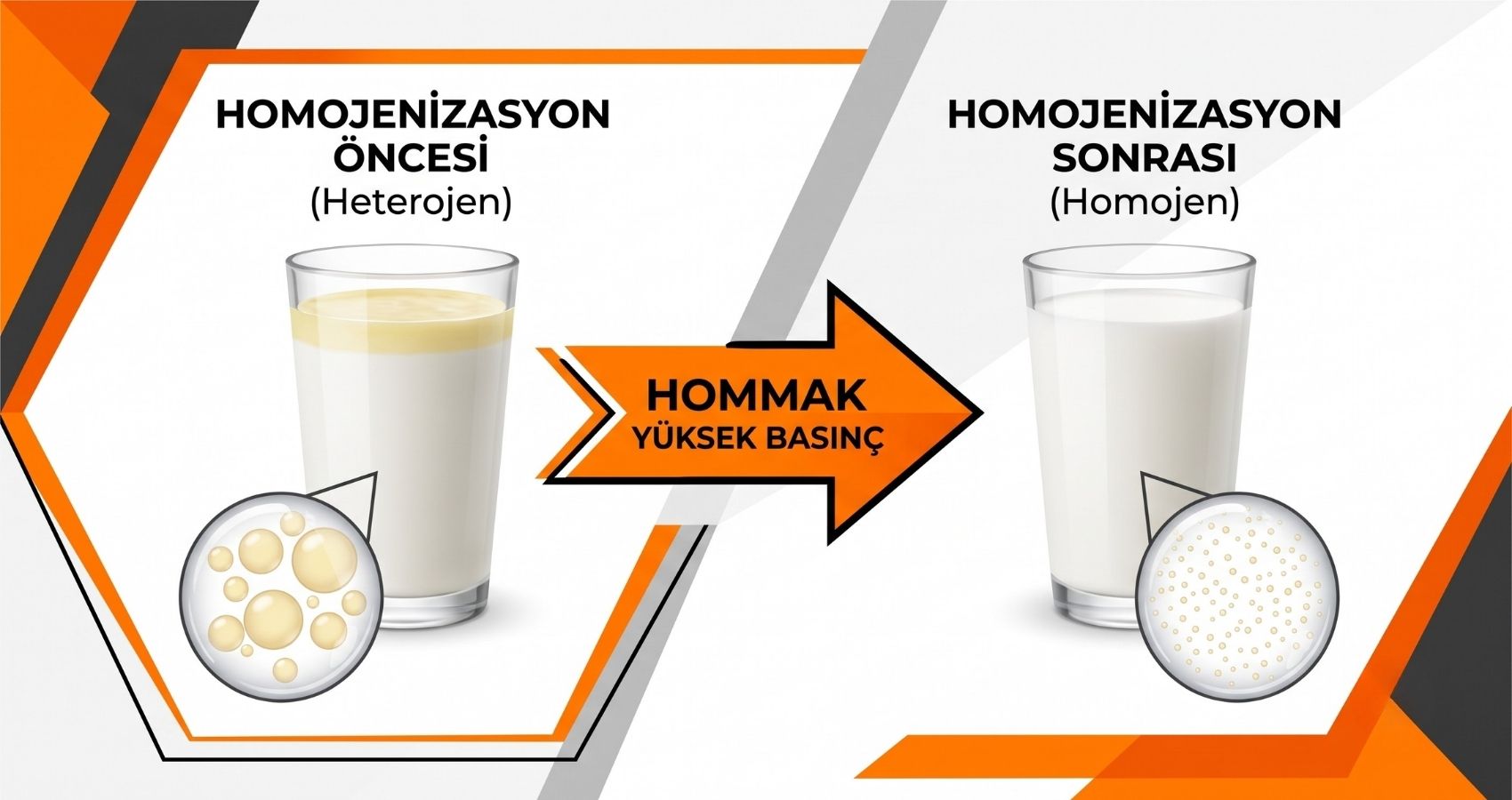
If you leave raw milk in the refrigerator for a few hours, a yellowish layer of cream collects at the top. This does not happen with the milk you buy from the supermarket. What makes the difference is not an additive, but a machine.
A homogenizer is an industrial machine that reduces fat droplets and solid particles within a heterogeneous liquid product to submicron sizes by forcing it through a very narrow gap under high pressure. The process is called homogenization, and the result is a stable mixture that does not separate on its own.
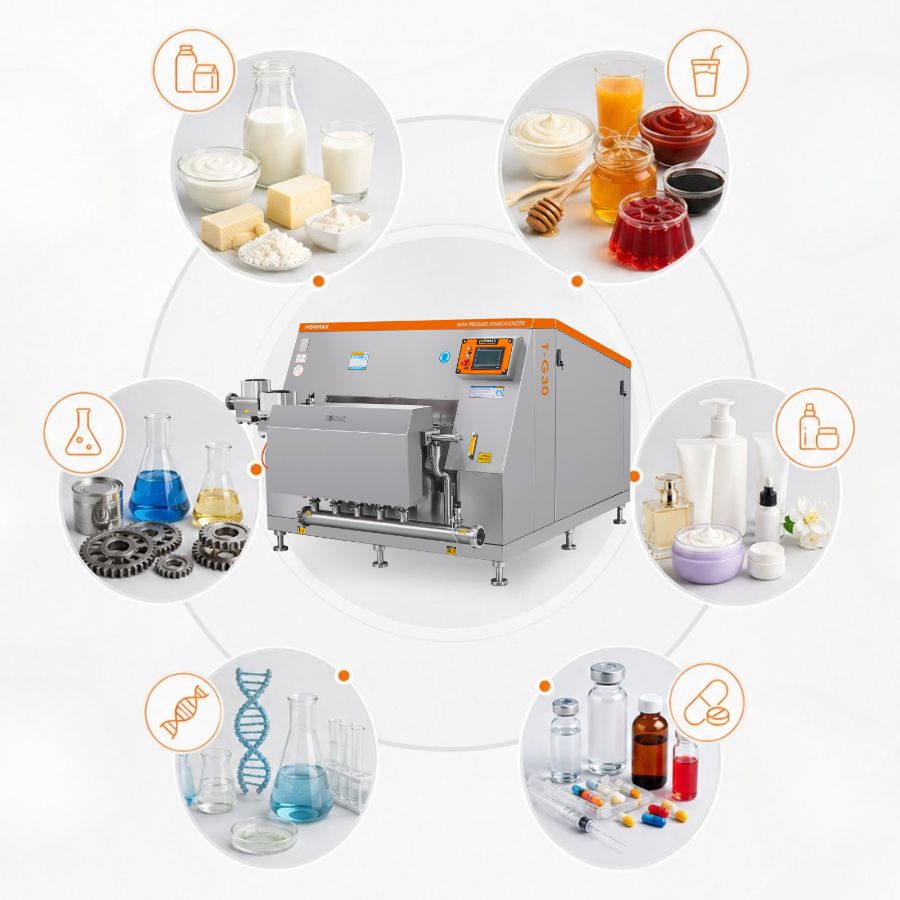
Milk is the most well-known example, but it is not the only one. Mayonnaise, shampoo, vaccine suspensions, and lubricating grease are also produced using the same physical principle. Below, we explain how a homogenizer works, which type serves which purpose, and what you should consider when choosing the right machine for your facility.
What is a Homogenizer?
A homogenizer is an industrial machine that reduces particle size and makes the mixture permanently homogeneous by forcing liquid products through a narrow valve gap under high pressure. It is used in dairy, food, cosmetics, pharmaceutical, and chemical production for emulsion stability, viscosity control, and shelf life.
The name of the process is homogenization. The machine is called a homogenizer. In Turkish, both “homojenizer” and “homojenizatör” spellings are used; the latter is the one established in the industry.
The idea is not new. Auguste Gaulin patented the pressurized valve system used to stabilize milk fat in 1899, and the dairy industry has been operating on the same basic physics ever since. What has changed are the pressure ranges, valve materials, and automation.
The Difference Between Homogeneous and Heterogeneous Structure
In a heterogeneous mixture, the components are in different phases and unevenly distributed. As long as there is a difference in density, gravity does its work: the lighter phase rises to the top, and the heavier phase sinks to the bottom. This is why a cream layer forms in raw milk and an oil layer forms in settled salad dressing.
In a homogeneous structure, however, the components are so small and so evenly distributed that separation practically stops. Homogenization increases the surface area by reducing the droplet size, and the proteins or emulsifiers coating the new surfaces prevent the droplets from recombining. You can also check out our article on how to prevent phase separation, where we discuss the process side of the topic in more detail.
Working Principle of a Homogenizer
A high-pressure homogenizer consists of two main parts: the piston pump block that generates the pressure and the homogenization valve that does the actual work. The majority of the machine’s body is the pump; homogenization, on the other hand, takes place in a palm-sized area.
Pressure Generation
The pump block typically contains three to five pistons. The crankshaft converts rotary motion into reciprocating motion, the pistons draw the product in and pump it into the high-pressure line. This is a positive displacement pump: it pushes a constant volume with each stroke, capacity is adjusted only by changing the rotational speed or piston diameter.
There is a commonly confused point in the field here. The pump does not determine the pressure, the valve does. As the gap between the valve and the seat narrows, the back pressure increases. Increasing the pump’s speed increases the capacity, not the pressure.
Passage through the valve gap
The pressurized product is forced into the micron-level gap between the valve and the seat. At this narrowing, the flow velocity increases to 100-300 m/s. The product remains in this zone for microseconds, not seconds.
Forces that break down particles
Three effects come into play simultaneously in the valve gap:
Because the pressure drops suddenly, vapor bubbles form within the liquid, and when the pressure recovers at the valve outlet, these bubbles violently collapse. This phenomenon, called cavitation, breaks down the droplets with localized shock waves.
The varying flow velocity within the cross-section creates shear stress. The droplet is pulled quickly on one side and slowly on the other, elongates, and breaks apart.
The high-velocity jet emerging from the gap strikes the impact ring. The remaining large droplets are broken up by this impact.
In the case of milk, the result is measurable. Fat globules with a diameter of 3-10 µm in natural milk are reduced to the 0.5-2 µm range after the process, and the total surface area of the fat phase increases four to six times. Casein and serum proteins immediately cover this newly exposed surface; the droplets cannot coalesce again and do not form a cream layer.
Single-stage and two-stage homogenization
In a single stage, there is a single valve, and the entire pressure drop occurs there. The problem is that the fragmented droplets tend to cluster as soon as they exit the valve, especially in high-fat products.
In a two-stage, a second low-pressure valve is placed after the first valve. Generally, a distribution like 150/50 bar is used: the first valve breaks them apart, the second disperses the formed clusters and stabilizes the flow. The two-stage is practically standard in drinkable milk, ayran, and yogurt lines. However, in some processes where clustering is desired, such as cream and butter, a single stage is preferred.
Homogenization heats the product
Almost all of the consumed energy is converted into heat. As a rule of thumb, the product temperature increases by 2-2.5 °C for every 100 bar. In a line operating at 400 bar, this means an increase of around 10 °C and must be included in the pasteurization and cooling calculations. In heat-sensitive formulations, this alone can change the pressure selection.
Homogenizer types
Not all machines sold in the market under the name “homogenizer” do the same job at the same scale. What determines the difference is the achievable particle size and the viscosity of the product.
High-pressure (valve type) homogenizer
The most common type in the industry. It operates between 200 bar and 1,500 bar, reaches down to the submicron level, and can operate on continuous lines at large capacities. It is the standard equipment for milk, beverages, sauces, cosmetic creams, and pharmaceutical emulsions. HOMMAK’s high-pressure homogenizer models ranging from 20 L/hour to 30,000 L/hour fall into this class.
Rotor-stator homogenizers (high-shear mixers)
It produces intense shear in the narrow gap between a rapidly rotating rotor and a stationary stator. It provides a coarser distribution compared to the valve type (typically 1-20 µm); however, it is much more practical for dissolving powder materials into liquid, for gum and stabilizer dispersion, and for viscous products. It can operate in-tank or in-line.
In this group, high-shear mixers, MicroCut with tungsten blades, and the multi-stage MicroMix in-line mixer meet different needs. In most facilities, the rotor-stator and valve types are not alternatives to each other, but two different steps of the same line: first dispersion, then homogenization.
Colloid mill
There is an adjustable gap between the conical rotor and the stator. It is preferred for high-viscosity and fibrous products, such as tahini, mustard, and fruit puree. Since the gap is mechanically adjusted, the particle size depends on the operator.
Ultrasonic homogenizer
It breaks down particles through the cavitation created by ultrasonic waves in the liquid. It is highly effective on a laboratory scale; comparative studies even show that under certain conditions, it yields smaller globule diameters than classical homogenization. When scaling up to an industrial level, energy efficiency and probe wear become limiting factors, which is why it is not common in large lines.
Laboratory and pilot plant type homogenizers
For recipe development, cell disruption, and scale-up studies. They can reach very high pressures in small volumes; 1,000-1,500 bar is a typical range at a capacity of 25-500 L/hour. The pressure and stage settings verified in R&D determine the specifications of the production machine.
Comparison table
| Type | Typical particle size | Operating range | Best suited for |
|---|---|---|---|
| High-pressure valve type | 0,1-2 µm | 200-1.500 bar | Milk, beverage, emulsion, pharmaceutical |
| Rotor-stator / high shear | 1-20 µm | 3.000 rpm | Powder dissolving, gum dispersion, viscous product |
| Colloid mill | 5-50 µm | Adjustable gap | Tahini, mustard, puree, fibrous product |
| Ultrasonic | 0,1-1 µm | 20 kHz civarı | Laboratory, small volume |
| Laboratory / pilot type | 0,05-1 µm | 400-1.500 bar | Recipe development, cell disruption |
Usage areas of homogenizers
Milk and dairy products
The oldest and largest application area. Homogenization stops cream separation, whitens the color of the milk, improves the gel structure and water-holding capacity in yogurt, and provides a creamier texture by reducing ice crystal formation in ice cream. In products like cream cheese and curd, it is directly a matter of spreadability. For details, you can visit our milk and dairy products homogenization solutions page.
Food and beverage
It prevents pulp settling in fruit juice, phase separation in sauces, and sediment formation in plant-based beverages. Homogenization is the step that determines the viscosity and mouthfeel in mayonnaise and ketchup. As the emulsion becomes stable, the amount of stabilizers and emulsifiers also decreases in most recipes.
Cosmetics
In cream, lotion, and shampoo, droplet size directly affects the product’s consistency, shine, and shelf life. High-pressure homogenization ensures that batches turn out identical to each other by producing fine and narrow-distribution emulsions.
Pharmaceutical and biotechnology
In pharmaceutical suspensions, the homogeneous distribution of the active ingredient is essential for dose consistency. In liposome and nanoemulsion production, pressures exceed 1,000 bar. In biotechnology, however, the homogenizer is not a mixer, but a cell disruptor: the cell wall is broken mechanically without using chemicals, and the protein or enzyme inside is released. In drug and pharmaceutical applications, the valve material and cleaning protocol are as decisive as the pressure.
Chemical and petrochemical
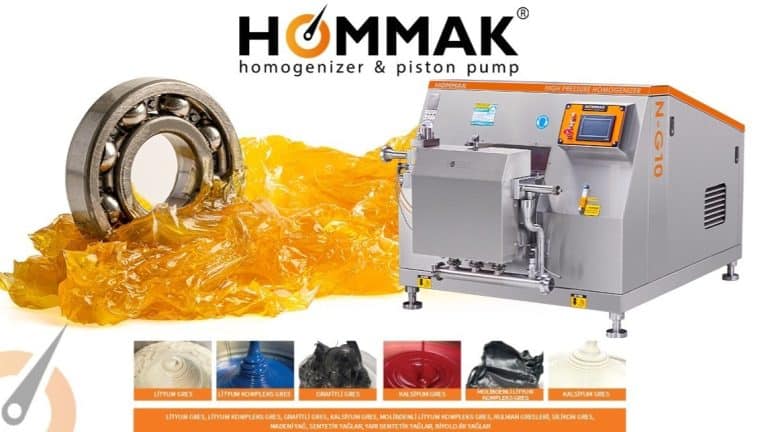
It is used for viscosity consistency and narrow particle distribution in the production of paint, detergent, resin, and grease. Thinning the soap fiber structure in grease directly affects the product’s penetration value and mechanical stability.
How to choose the right homogenizer?
When requesting a quote, there are items you need to look at in the table presented to you besides pressure and capacity.
Pressure. Choose the value your product requires, not the highest value you can reach. Unnecessarily high pressure increases the energy bill, heating, and valve wear; in some products, it worsens the result by causing fat clustering.
Capacity. Calculate it based on the actual flow rate of the line. Since the homogenizer works with positive displacement, you do not want it to wait idle for a long time.
Viscosity and temperature. If the feed pressure is insufficient in viscous products, the pump will cavitate. This is one of the most common reasons that shortens the life of the piston and valve.
Hygiene and cleaning. In food, dairy, and pharmaceutical lines, CIP compliance, surface roughness, and gasket material are non-negotiable.
Energy consumption and piston speed. There can be a significant difference between the kW consumption of two machines with the same capacity. Machines operating at a low piston speed produce less vibration, and the spare part replacement interval is extended.
Service and spare parts. The valve, seat, and pistons are wear parts. The supply time is your line’s downtime.
Approximate pressure ranges by product
| Product / application | Typical pressure |
|---|---|
| Drinkable milk, ayran, yogurt | 150-250 bar |
| Ice cream mix, cream, cream cheese | 200-400 bar |
| Sauce, mayonnaise, fruit juice | 200-350 bar |
| Cosmetic cream and lotion | 300-600 bar |
| Grease, paint, resin | 400-800 bar |
| Nanoemulsion, liposome | 800-1.500 bar |
| Cell disruption (biotechnology) | 1.000-2.000 bar |
The table is a starting point. The exact value is determined by a pilot trial based on the recipe and the targeted particle size.
Four common mistakes we encounter in the field
Setting the pressure unnecessarily high. “The more, the better” does not apply here. Excessive pressure wastes energy, heats the product, and triggers clustering in some recipes.
Placing the homogenizer on the wrong side of the heat treatment. In milk, the homogenizer is usually activated after the heating section of the pasteurizer, at around 60-70 °C. Homogenizing cold product both reduces efficiency and strains the machine.
Continuing production with a worn valve. As the valve and seat surfaces wear out, a different particle distribution emerges at the same pressure value. Even if the product appears to be in spec, its shelf life is shortened. Including particle size measurement in the periodic checklist catches such deviations early.
Neglecting the feed line. If there is not enough net positive suction head at the pump’s intake, cavitation begins. The result: noise, vibration, and prematurely failing pistons.
Frequently asked questions
What does a homogenizer do? A homogenizer prevents the mixture from separating by reducing the size of fat droplets and solid particles in the liquid product. It improves the viscosity, color, texture, and shelf life of the product. Since the emulsion becomes stable, the need for stabilizers and emulsifiers is also reduced in most recipes.
At what pressure does a homogenizer operate? It varies between 150 bar and 2,000 bar depending on the application. In milk and beverage production, 150-250 bar is usually sufficient. Values of 300-600 bar are used in cosmetic emulsions, over 800 bar in nanoemulsion and liposome production, and over 1,000 bar in cell disruption.
What is the difference between a homogenizer and a mixer? A mixer mixes the components together, whereas a homogenizer breaks down particles. A mixer cannot produce submicron droplets; the product coming out of the homogenizer is physically in a permanent emulsion state. In practice, the two generally complement each other: the mixer does the preliminary preparation, and the homogenizer provides the final size.
What is homogenized milk? Homogenized milk is milk in which the fat globules have been reduced to the 0.5-2 µm range with a high-pressure homogenizer. A cream layer does not form on the surface, and the fat is distributed evenly throughout the milk. The process does not change the nutritional composition of the milk; the fat, protein, and mineral content remains the same.
How is the price of a homogenizer determined? The main factors determining the price are capacity (L/hour), maximum operating pressure, valve and piston material, automation level, and hygienic design requirements. There is a significant difference between two machines of the same capacity at 200 bar and 1,000 bar, which is why a quotation based on process analysis is provided instead of a list price.
Should every product be homogenized? No. Using homogenized milk in hard and semi-hard cheese production softens the curd too much and makes it difficult to release its whey. In butter production, however, it is desired that the fat globules remain together. Homogenization is a step decided based on the product.
A homogenizer is a machine that permanently changes the physical structure of a liquid product. What it does is simple: it applies pressure and breaks down particles. Getting the right result depends on configuring the pressure, number of stages, valve design, and location in the line together.
HOMMAK has been manufacturing high-pressure homogenizers and piston pumps since 2004. We have over 3,000 actively running units worldwide, and the machines are designed according to the customer’s process.
If you would like to discuss which pressure and capacity are suitable for your product, you can write to us via our quotation form.