
Aseptic Homogenizer in UHT Milk Production: Before or After Sterilization?
When planning a UHT line, you need to decide early where the homogenizer goes, because this choice fixes the machine type, its price and its maintenance routine from the start. If the homogenizer runs before sterilization, an ordinary (non-aseptic) machine may be enough. If it will run after sterilization, the machine itself must also stay sterile, and that means an aseptic homogenizer . The difference in price and maintenance between the two is not small.
In this article we explain what the two positions mean in UHT milk homogenization, which one is preferred for which product and heating system, and which questions you should ask when deciding. For the basic principle of homogenization, see our article on what a homogenizer is .
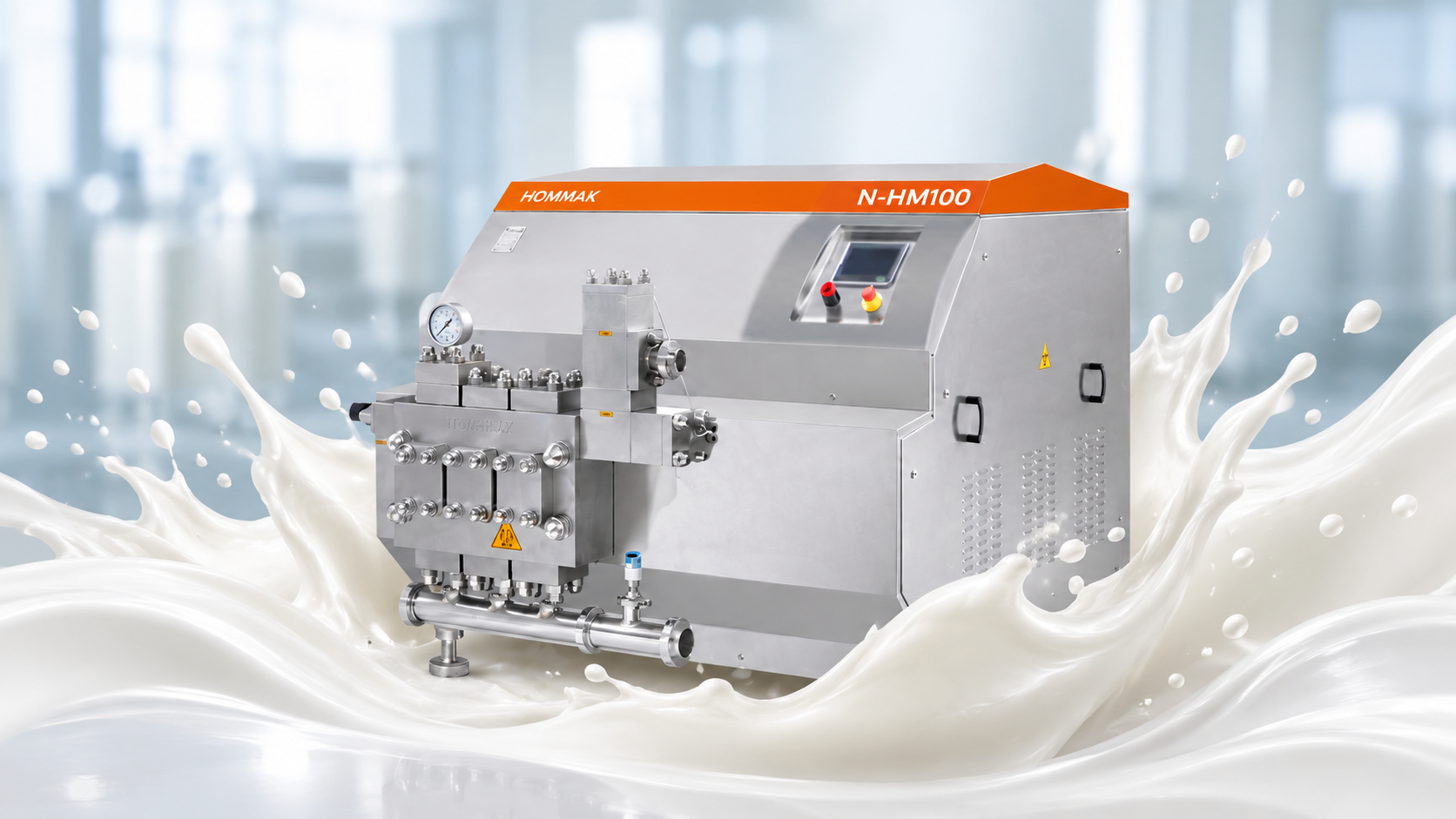

Two possible positions on a UHT line
In UHT (ultra-high temperature) treatment, milk is raised to about 135-150 °C, held for a few seconds and cooled. The aim is a commercially sterile product that can be stored for months at room temperature. The homogenizer is placed at one of two points on this line:
- Upstream: The homogenizer runs before the sterilization section, while the milk is still in the preheating stage (usually 65-80 °C). The machine does not have to be aseptic.
- Downstream: The homogenizer runs after the sterilization and holding section, while the product is sterile. The machine must be of aseptic design.
Which one is chosen mostly depends on the type of heating system and the fat content of the product.
Upstream homogenization: simple, cheap, often sufficient
In indirect UHT systems (with plate or tubular heat exchangers), placing the homogenizer before sterilization is a common solution for plain milk. The product is not yet sterile, so there is no microbiological risk inside the homogenizer and a normal hygienic machine can be used.
Advantages:
- The machine is cheaper and its maintenance is that of an ordinary homogenizer.
- There is no sterility risk; no contamination scenario originating from the homogenizer is carried down the line.
- Operation and operator training are simpler.
The limitation is this: after homogenization the milk rises to around 140 °C. During heat treatment, whey proteins denature and can form bonds on the surface of the fat globules and between globules. In products with high fat content, this can cause the globules to cluster again during heating. In low-fat products such as plain milk, this effect is generally at an acceptable level.
Downstream (aseptic) homogenization: breaks up clusters after sterilization
In the downstream position, the homogenizer processes the product after sterilization. Clusters formed during heat treatment are broken up at this point, and the fat globule distribution is set for the final product. For this reason it is preferred in the following cases:
- In direct-heating UHT systems (steam injection or infusion). In these systems homogenization is generally carried out after heat treatment, with an aseptic-type machine.
- In products with high fat content, such as cream, high-fat milk and coffee creamer.
- In formulations that risk cream separation or sedimentation during storage, such as flavored milk, plant-based drinks or high-protein drinks.
- In products with a long shelf life and high stability expectations (if the product will sit for 6-12 months at room temperature, consistency becomes more critical).
Comparison table
| Criterion | Upstream (non-aseptic) | Downstream (aseptic) |
|---|---|---|
| Position | After preheating, before sterilization | After sterilization and holding |
| Machine type | Standard hygienic homogenizer | Homogenizer of aseptic design |
| Investment cost | Low | Significantly higher |
| Maintenance | Ordinary schedule | More frequent and more thorough (sterile barrier, seal checks) |
| Sterility risk | None | Contamination risk at the seal and valve area; must be managed |
| Cluster control | Clustering may occur after heat treatment | Clusters broken up after heat treatment |
| Typical product | Plain milk (indirect heating) | Cream, flavored milk, plant-based drinks, direct-heating systems |
Does an aseptic homogenizer work differently?
The homogenization principle is the same: pressure, valve gap, cavitation and shear. The difference is in how the machine is designed so that its product-contact parts can stay sterile.
In an aseptic homogenizer, the piston and seal area is continuously surrounded by a sterile barrier (steam or sterile water). During the piston’s back-and-forth movement, no path open to the outside air may remain through the seal area. Before production starts, the product-contact section of the machine is sterilized with steam (SIP), the barrier continues throughout production, and parameters such as pressure and temperature are monitored.
This design has two consequences. First, the machine is more complex and more expensive. Second, a fault in the seal area can pass directly to the sterile product. That is why the replacement interval of seal sets, the quality of the barrier water or steam, and regular checks require extra discipline on an aseptic machine.
Five questions to ask when deciding
- Is your heating system indirect or direct? In direct systems the downstream option is often effectively mandatory.
- What is the fat content of your product? Plain milk and cream or high-fat drinks are not assessed in the same way.
- What are the shelf life and storage conditions? For products that will sit for a long time at room temperature, tolerance for separation is low.
- Do you have a team and a spare parts system to maintain an aseptic machine? If not, do not see the cost item as just the price of the machine.
- Will more than one product run on the same line? On a multi-product line flexibility matters more; on a single-product line, simplicity does.
Pressure and temperature: how are the numbers chosen?
For UHT milk, homogenization pressure is mostly in a total range of 150-250 bar, applied in two stages. A setting such as 150/50 bar, for example, reduces the fat globules in the first stage and breaks up the clusters formed in the second stage. As fat content increases, the first-stage pressure is usually lowered and the share of the second stage rises.
Product temperature is also critical. Upstream, homogenization is done at about 65-80 °C, because the fat must be completely liquid. Downstream, the product is arranged to enter the homogenizer at around 70-80 °C in the post-sterilization cooling stage, and is then cooled to filling temperature. The correct values must be set by engineering calculation, according to the product and line design.
Pressure values are a starting point. The same milk may behave differently with a different supplier, season or fat content, and a fixed recipe should not be written without a pilot trial and particle size measurement.
Items to consider in the investment calculation
When buying an aseptic homogenizer, looking only at the machine price is misleading:
- The purchase price of the aseptic machine and the aseptic valve / sterile barrier equipment
- Steam or sterile water preparation and control infrastructure for the sterile barrier
- Replacement interval of seal and piston sets, spare parts stock
- Restoring the sterile state of the line after maintenance (SIP time, downtime)
- Training of operators and the maintenance team
- If necessary, a validation and microbiological monitoring plan
The pasteurization unit and the CIP line and other surrounding equipment must also be compatible with this decision. If the whole line is being designed, it is healthier to treat the homogenizer not as a separate item but as part of the heating system.
Quality problems seen in UHT milk and the share of homogenization
Most complaints about long-life milk arise on the shelf, that is, weeks after production. Telling which of them are related to homogenization is half the work of choosing the right investment.
| Shelf problem | Appearance | Relation to homogenization |
|---|---|---|
| Creaming | Fat ring or layer at the top of the bottle | High. Droplets are not small enough or clusters have formed |
| Fat lumps | Large pieces floating in the milk | High. Small globule clusters, especially in high-fat products |
| Sediment at the bottom | Fine deposit at the bottom of the bottle | Partial. Protein stability, heat treatment intensity and salt balance are more decisive |
| Gelation (age gelation) | Thickening and gel after weeks | Low. Protease activity and heat treatment conditions stand out |
| Bitter taste | Fat and protein degradation developing during shelf life | Low. Raw material quality and enzyme activity are decisive |
Improving homogenization solves the first two problems; it does not solve the last three. So instead of deciding “we have a shelf-life problem, let’s buy a homogenizer”, first look at which row the problem is in.
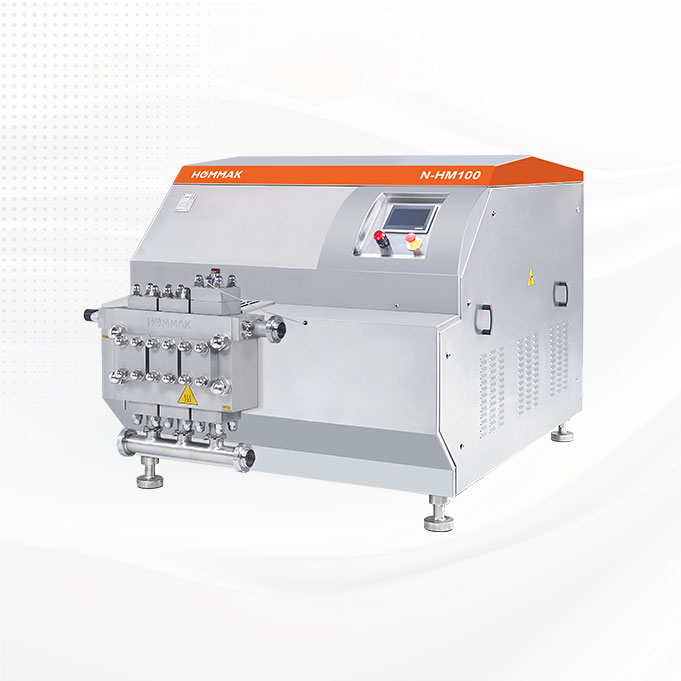
How is homogenization success measured?
Two simple measurements are enough to verify the recipe and the machine setting:
- Particle size measurement. The mean size of the fat globules is checked with a laser diffraction instrument (usually the volume-weighted d43 or d90). The target is mostly around 1 µm or below. The target value is set by your product’s shelf life and fat content.
- Hold test. A sample is held at a given temperature (for example 20-25 °C and 4 °C) and checked at set intervals for cream layer and sediment. When done together with commercial sterility tests, it predicts the behavior of the product over its shelf life.
If you are considering a change to downstream (aseptic), trying the same milk batch in two configurations and comparing these two measurements is the most solid way to decide. If there is no pilot facility, start with the data of the existing line: record the frequency of creaming and lumps in post-filling samples for a month.
Decision summary
- Indirect-heating UHT (plate or tubular), standard fat content and a reasonable target shelf life: upstream homogenization is usually sufficient and gives the lowest investment and operating cost.
- Direct-heating UHT (steam injection or infusion): homogenization is generally done after heat treatment, with an aseptic-type machine.
- High-fat product (cream, coffee creamer, some milk-based drinks) or a very long shelf-life target: downstream homogenization should be considered.
- If you are unsure: measure the current problem, run a pilot trial, then invest.
Frequently asked questions
What is an aseptic homogenizer?
An aseptic homogenizer is a homogenizer that processes the product in its sterile state after sterilization and is designed to keep its product-contact areas sterile. The piston seal area is protected by a steam or sterile water barrier, and the machine is sterilized with SIP before production. In this way the product is homogenized while remaining sterile.
In UHT milk, is the homogenizer used before or after sterilization?
Both positions are used. In indirect-heating systems, for plain milk the homogenizer usually runs before sterilization. In direct-heating systems, in cream and high-fat products, and in formulations with high stability expectations, it is used after sterilization with an aseptic-type machine.
Why is an aseptic homogenizer more expensive?
In an aseptic machine the piston seal area is protected by a sterile barrier, product-contact surfaces are designed to be SIP-compatible, and there is additional monitoring equipment. These design and material requirements lead to higher production and maintenance costs than a standard homogenizer. A non-aseptic machine does not need this equipment, because the product is not yet sterile.
What homogenization pressure should be used for UHT milk?
For UHT milk, pressure is generally in a total range of 150-250 bar with two-stage operation, for example 150/50 bar. As fat content rises, the first-stage pressure is lowered and the second-stage share is increased. The exact setting should be determined by pilot trial according to the product and target particle size.
Does every UHT line need an aseptic homogenizer?
No. If plain milk is processed on an indirect-heating line, a standard homogenizer running before sterilization is often enough. An aseptic machine is needed in direct-heating systems, in products with high fat content or sensitive stability, and where clustering after heat treatment must be controlled.
Let’s plan your UHT line together
If you share your line’s heating type, your product list and your target shelf life, we can assess the right position and machine type for the homogenizer together with our engineering team. We handle aseptic configuration requests on a project basis. To get started you can use the quote form .