Partial Homogenization: Cut Capex and Energy Costs
You are buying a homogenizer for a dairy line, and the quote lists the capacity of the entire line: 10,000 L/hour. But does this machine really need to process 10,000 L/hour? On most drinking milk and yogurt base lines, it does not. With partial homogenization (split-stream homogenization) you can reach the same result by processing all of the fat through only about a third of the flow.
In this article we explain how the method works, how much difference it makes to capacity and energy, which lines it does not suit, and how to set it up correctly. If you want to refresh the general principle first, see our article on what a homogenizer is and how it works .

What is partial homogenization?
Partial homogenization is a method in which you do not homogenize all of the milk, but only a fraction with a raised fat content: the cream. The milk is first split in a separator into skim milk and cream. The cream is homogenized, then blended back with the skim milk, and standardization is completed at that point.
The logic is simple. The purpose of homogenization is to reduce the size of fat globules. Skim milk contains almost no fat to break up. Sending it through high pressure uses energy and makes the machine bigger, but contributes nothing to the result. The cream stream, on the other hand, carries almost all of the fat.
| Full-stream homogenization | Partial (split-stream) homogenization | |
|---|---|---|
| Stream processed | All of the milk | Cream fraction only |
| Homogenizer capacity | Equal to line flow rate | About 25-40% of line flow rate |
| Additional equipment | Not required | Separator and standardization line |
| Energy consumption | High | Significantly lower |
| Fat phase control | All of the milk | Cream (all of the fat) |
| Suitable lines | Ayran, yogurt, lines starting from raw milk | Drinking milk and milk base lines with a separator |
Why does it work? A simple capacity calculation
Let us put numbers on it. Consider a 10,000 L/hour line processing standardized milk with 3.5% fat. About 350 kg of fat flows through this line every hour. If you take a cream with 10% fat from the separator, the cream stream carrying this fat is about 3,500 L/hour. The skim milk (about 6,500 L/hour) never enters the homogenizer.
- In full-stream mode the machine processes 10,000 L/hour.
- In partial-stream mode the machine processes 3,500 L/hour.
- Because pump and motor load fall in proportion to the processed flow at roughly the same pressure, energy consumption also falls by about two thirds.
This is an estimate; the real value varies with the line’s fat standardization, the fat content of the cream and the pressure setting. But the order of magnitude is right: you size the homogenizer for the fat-carrying stream, not for the entire line.
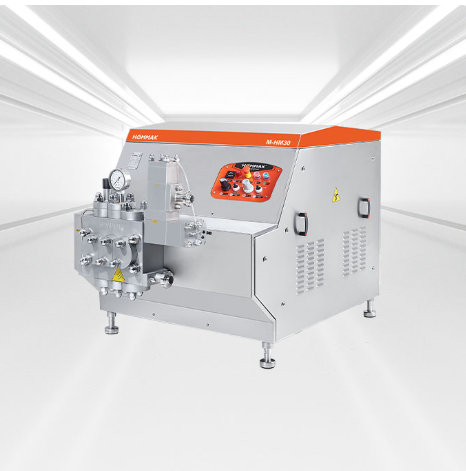
Using HOMMAK catalog values, a model such as the N-G10 would be needed for 10,000 L/hour at 200 bar, while for a 3,500 L/hour cream stream a machine in the A-HM60 class, with a capacity of 5,000 L/hour at 200 bar, is often sufficient. The difference is not only the purchase price. Motor power, transformer and panel requirements, foundation, CIP flow rate and the spare parts set all become smaller too. The exact model for your plant can only be selected from product and pressure data; you can see the product range on our high-pressure homogenizers page.
Why is the cream fat content critical?
The most common mistake in partial homogenization is keeping the cream fat content too high. The reason is this: when homogenization reduces the size of the fat globules, the total fat surface area increases several times over. This new surface has to be covered with protein (especially casein). The amount of protein in the cream phase is limited. If the fat content is too high, the new surfaces cannot be covered, droplets stick together and fat clusters form. The result is the opposite of what you want: a product that is homogenized but clustered.
In practice the following framework is used:
- The fat content of the cream to be homogenized is generally kept in the 10-12% range. Above that, the risk of clustering rises markedly.
- As fat content rises, the second stage (the low-pressure second valve) becomes even more important for breaking up clusters.
- The cream can be brought down to this level by diluting it partly with raw milk or skim milk.
The exact value depends on the product, the protein content and the target globule diameter, so a fixed number should not be trusted without a pilot trial.
Line setup: equipment and sequence
A typical partial homogenization line works in this order:
- Raw milk is heated (usually to 55-65 °C) and sent to the separator.
- The separator splits skim milk and cream.
- The cream to be homogenized is adjusted to a fat content of about 10-12%; cream that is too rich is diluted with skim milk.
- The cream is processed in the homogenizer in the 150-250 bar range (single or two stage).
- The homogenized cream is blended in-line with the skim milk.
- The blend goes to pasteurization (this is where the HTST pasteurization unit comes in).
If two details are set up wrongly, the saving is lost. The first is homogenizer temperature: homogenization is efficient at a product temperature of 55-70 °C; in cold cream the fat is partly solid, so the globules are not broken up properly. The second is the back-blending point: the homogenized cream must be blended into the skim milk with flow control before the pasteurizer, and the fat content must be measured on the line.
Which lines is partial homogenization not suitable for?
This is not the right method for every plant. Full-stream homogenization is preferred in the following cases:
- No separator. Partial homogenization needs a separator. If your existing line does not have one, the separator investment can eat up the gain.
- Ayran and yogurt lines. In these products the aim is not only to reduce the fat globule but also to influence the protein network and water-holding capacity. Homogenizing the whole milk base is the safer choice for texture. We covered this in our article on the role of homogenizers in fermented dairy products .
- Small plants with low flow rates. On 1,000-2,000 L/hour lines, the cost of the separator and extra piping can outweigh the gain from a smaller homogenizer.
- Plants with very frequent recipe changes. On lines that run different fat contents and change products often, controlling a partial stream is harder.
- Long shelf-life (UHT/ESL) products. There is no single mandatory solution for these; whether to homogenize before or after UHT is a separate engineering decision.
Checklist for the investment decision
Before deciding whether partial stream suits you, get clear answers to these questions:
- Is there a separator on the line, or will one have to be purchased?
- What are the daily milk volume and the product types?
- Is the fat content of the final product fixed or variable?
- Can you measure and control the cream fat content on the line?
- Where will the homogenizer be installed in relation to the pasteurizer?
- Is there a capacity expansion plan? If the line grows in the future, will a partial-stream homogenizer still be enough?
The last question is important. A machine selected today for 3,500 L/hour will be too small if the line grows to 15,000 L/hour. If you have a growth plan for the line, you need to say so at the quotation stage.
The three most common mistakes in the field
Partial homogenization is simple on paper. In the field, three mistakes keep recurring and eat away the saving.
Running without measuring the fat content. If the cream fat content rises above the target, the globules stick together and cluster during homogenization, and creaming returns. If it drops below the target, the homogenizer processes needlessly thin milk, and the saving is lost. In-line fat measurement, or at least regular sampling, is the insurance of the whole setup.
Copying the pressure from the milk line. The familiar 150/50 bar setting from full-stream homogenization may not apply directly to cream. On a high-fat stream, excessive pressure can increase clustering. Determine the pressure by pilot trial, according to the fat content of the cream.
Neglecting the feed to the homogenizer. Cream is viscous and must reach the homogenizer inlet smoothly, free of bubbles and at steady pressure. If the feed tank level fluctuates, the piston strokes into a void, the pump vibrates and the valve setting becomes meaningless. A small pre-feed tank and the right pipe diameter are often enough.
Investment comparison: what to look at
A “smaller homogenizer” is only one line item of the saving. When comparing the partial-stream setup with full stream, put these items side by side:
| Item | Full-stream homogenization | Partial homogenization |
|---|---|---|
| Homogenizer capacity | Total milk flow | Cream flow only |
| Motor and electrical infrastructure | Large motor, higher-rated panel and cable | Smaller motor |
| Energy consumption | High | Lower in proportion to the cream flow |
| Separator and extra pump | May not be needed (if one exists) | Existing separator is used; extra pump and piping may be needed |
| Automation | Simple | Additional measurement for fat content and flow control |
| Spare parts and maintenance | Larger piston and seal sets | Smaller sets |
| Flexibility | Every product on the same line | Setup needed per product |
The decision should be made only after you have filled in each row of the table with figures for your own plant. If the plant already has a separator, partial homogenization becomes much more attractive. If there is no separator, the extra investment takes back part of the saving.
Frequently asked questions
What is partial homogenization?
Partial homogenization is a method in which you do not homogenize all of the milk, but only the cream fraction with a raised fat content. The milk is split into skim milk and cream in a separator, the cream is homogenized and then combined with the skim milk. This allows a homogenizer of smaller capacity to be used.
How much energy does partial homogenization save?
Homogenizer energy is roughly proportional to the processed flow. Since the cream stream is about 25-40% of the total flow, depending on the line’s fat standardization, a similar reduction in homogenizer energy consumption can be expected. The real saving should be worked out for your plant, taking separator and extra pump energy into account.
Why should the cream fat content not exceed 10-12% in homogenization?
Homogenization increases the fat surface area, and the new surface has to be covered with protein. Protein in cream is limited. If the fat content is too high, the surfaces cannot be covered and the globules merge to form fat clusters. For this reason the content is generally kept at around 10-12% in practice, and a second-stage valve is used.
Can partial homogenization be applied to ayran and yogurt?
In these products the whole milk base is usually homogenized, because homogenization affects not only the fat globule but also the protein network and water-holding capacity. Partial homogenization can be tried on some yogurt lines, but switching is not recommended without texture and syneresis tests.
What pressure is used for partial homogenization?
The 150-250 bar range is generally used for milk and cream. In two-stage operation the first stage is set high and the second stage at low pressure. Exact values depend on fat content, temperature and target globule diameter, and should be confirmed by pilot trial.
Get it calculated for your line
Whether partial or full stream is right depends on your fat standardization, your existing equipment and your growth plan. Share your daily milk volume, your product types and your current line diagram, and HOMMAK engineers will compare the two methods on capacity, energy and investment. You can start by filling in the quote form .