Ice Cream Mix Homogenization: Pressure, Temperature and Creamy Texture
Two ice creams made from the same recipe in two different plants can feel completely different in the mouth. One melts like velvet, while the other is gritty or too “sticky”. The difference is often not in the sugar or the milk powder but in the mix preparation line, and the ice cream homogenizer is the machine on that line with the greatest effect on texture.
In this article we explain how pressure, stage and temperature relate to texture in ice cream mix homogenization, which defects a wrong setting causes, and what to look at when choosing a machine for your plant.
Why is ice cream mix homogenized?
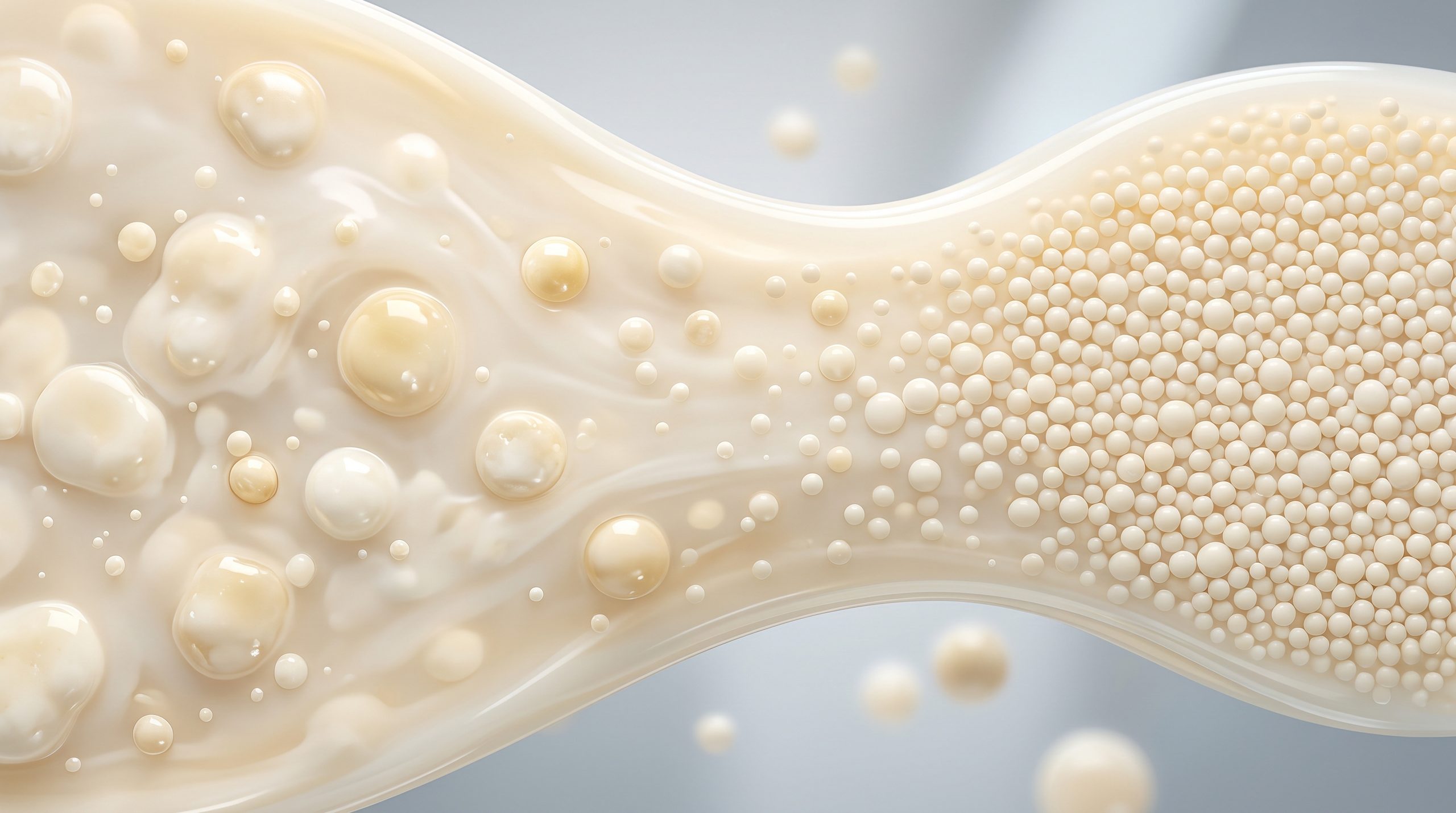
Ice cream mix is a fat-in-water emulsion: fat from milk or cream (mostly 8-16%), non-fat milk solids, sugar, stabilizer and emulsifier. In the mixture leaving the blending tank, the fat globules are of different sizes and some of them are large. The homogenizer reduces these globules to around 1 µm.
This has four direct effects on the mix and the ice cream:
- It prevents fat separation. No cream layer forms in the ageing tank or in the feed to the freezer.
- It improves body and mouthfeel. Small, numerous globules make the mix be perceived as more viscous and creamier.
- It improves air retention. During freezing, fat globules build a structure around the air bubbles. Well-distributed fat means a more stable foam.
- It can shorten ageing time. A finer, evenly distributed fat phase, together with hydration of the stabilizer, speeds up the maturing of the mix.
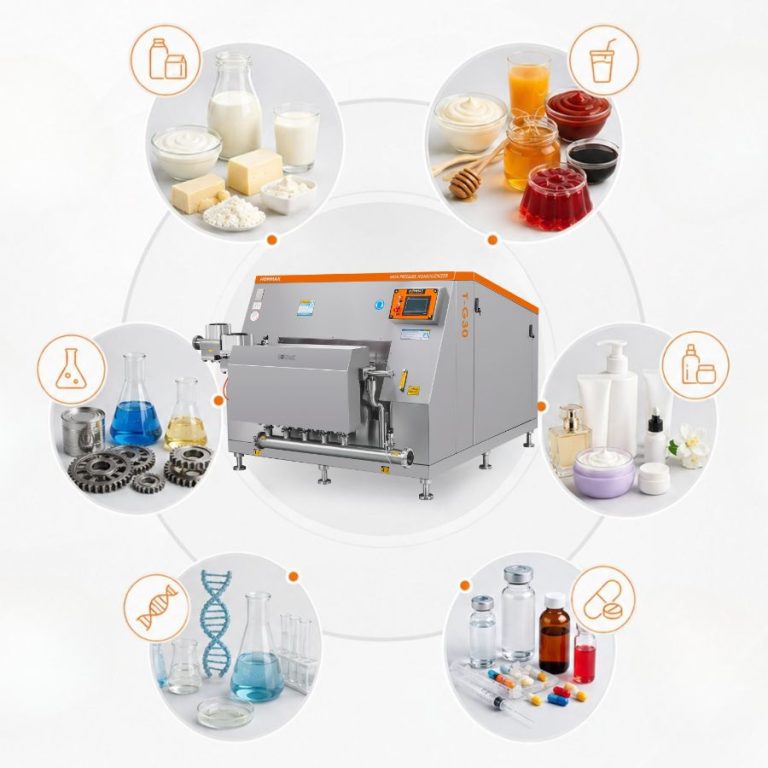
On HOMMAK’s high-pressure homogenizer page, ice cream production is listed as an application that stabilizes fat globules, reducing ice crystallization problems and giving a creamier texture.
Its place on the line: before or after pasteurization?
A typical ice cream line runs as follows: raw materials are blended at 40-50 °C, the mix is heated to 65-70 °C, homogenized, pasteurized, cooled to 2-4 °C and held in an ageing tank for at least 4 hours. It is then frozen in the freezer and moved to the hardening room.
In practice two arrangements are seen:
- Homogenization before pasteurization. The most common arrangement. The mix enters the homogenizer at preheating temperature (65-75 °C) and then goes to the pasteurizer. Heat treatment also destroys any microbiological load coming out of the homogenizer.
- Homogenization after pasteurization. In some continuous lines it is done at the pasteurizer outlet. In this case the homogenizer must be operated with greater hygienic sensitivity and the CIP program must be set up accordingly.
In both cases the mix temperature should not fall below about 65 °C so that the fat is completely liquid. In cold mix the fat is partly solid and cannot be broken up properly.
Pressure and stages: why “more” is not better in ice cream
The typical approach for ice cream mix is two-stage:
| Parameter | Typical range | Note |
|---|---|---|
| First stage | 140-210 bar | Breaks up the fat globules |
| Second stage | 30-50 bar | Breaks up the clusters formed |
| Temperature | 65-75 °C | Fat must be completely liquid |
| Target globule diameter | 0.5-1.5 µm | Varies with the recipe |
| Mix with high fat content (12% and above) | Pressure is lowered, second-stage share increased | Reduces the risk of clustering |
At high fat contents, raising the pressure can backfire. When the fat surface area increases too much, protein cannot cover the new surfaces sufficiently, the globules stick together and the viscosity of the mix rises more than it should. This mix becomes a product that is hard to pump, behaves “sticky” in the freezer and has difficulty holding air. The same is seen in single-stage operation; the function of the second stage is exactly to open up these clusters. Pressure values are a starting point; they must be confirmed by pilot trial for the recipe.
What does homogenization do during freezing? (the partial coalescence question)
One phenomenon is enough to understand ice cream texture: partial coalescence of fat . In the freezer the mix is both frozen and agitated. The fat globules are partly crystallized, and when the emulsifier displaces the protein on the globule surface, the globules partly stick to each other and form a network. This fat network wraps around the air bubbles and gives the ice cream a dry, firm structure that keeps its shape as it melts.
Homogenization is the balancing element here:
- With insufficient homogenization, the globules stay large, creaming occurs in the mix, and uncontrolled fat clumping can be seen during freezing.
- With excessive homogenization, the globules become too small and too stable, and partial coalescence does not occur enough. The ice cream stays “wet”, melts quickly and loses its shape.
So the target is not the smallest possible globule, but a globule distribution compatible with the recipe’s emulsifier system. That is why the emulsifier and the homogenization setting are designed together.
Signs of incorrect homogenization
| Observation | Possible homogenization-related cause |
|---|---|
| Mix forms a cream layer, fat on the surface in the ageing tank | Pressure low, temperature low or valve worn |
| Mix excessively thick, hard to pump | Too much pressure for the fat content, single stage, clustering |
| Low overrun, unstable foam | Insufficient fat dispersion or excessive homogenization |
| Fast melt, poor shape retention | Excessive homogenization, insufficient partial coalescence |
| Fat lumps in the ice cream, buttery taste | Excessive churning or insufficient protein coverage of the surface |
| Gritty texture | Mostly caused by lactose or ice crystals; not solved by homogenization alone |
Let us stress the last one separately: gritty texture is not always a homogenization problem. Lactose crystallization, heat shock and a low solids content give the same symptom. Changing the pressure without a root cause analysis wastes time.
Choosing a homogenizer for an ice cream plant
Capacity
The homogenizer is selected according to the flow rate of the mix preparation line. In batch production, 500-2,000 liters of mix are prepared in the mix tank and fed to the pasteurizer and homogenizer at a rate of 1,000-3,000 liters per hour. HOMMAK’s F-HM20 (2,000 L/hour at 200 bar), M-HM30 (3,000 L/hour) and A-HM60 (5,000 L/hour) models fall in the range that covers most small and medium ice cream plants (catalog values, from the product page).
Pressure range
200-250 bar is enough for ice cream. Buying models that need higher pressure raises energy and wear costs and does not improve the result. In this respect ice cream mix differs from cosmetic and pharmaceutical applications that go to 600 bar and above.
Seasonality and flexibility
Many ice cream producers run at high capacity in the summer months and low capacity in winter. When choosing a machine, think not about average capacity but about summer peak demand and, if possible, off-season use (for example milk desserts, pudding, kefir base). The same homogenizer can be used for these products too.
Hygiene
Mix is subject to dairy hygiene rules. CIP compatibility, smooth interior surfaces and an easily dismantled valve group are therefore important. A line designed together with the CIP line and the HTST pasteurization unit gives fewer compatibility problems than equipment bought separately.
Other dairy products in the same family
Plants that make ice cream usually also process other products under the dairy umbrella. We have covered the role of homogenization in milk-based products on our milk and dairy products application page and in our article on the role of homogenizers in cream cheese production .
Starting points by ice cream type
The ranges below are only a starting point for trials. The optimum changes as fat content, dry matter, stabilizer type and emulsifier use change.
| Product | Fat content (approx.) | Dry matter | Point to watch |
|---|---|---|---|
| Classic milk-based ice cream | 8-12% | High | Two-stage homogenization; the second stage is important to prevent clustering |
| Premium (high-fat) ice cream | 14-18% | High | Keeping pressure low at high fat prevents clustering |
| Low-fat ice cream | 2-5% | Medium | Stabilizer and protein balance are more decisive for texture |
| Plant-based ice cream | Variable | Variable | A separate pilot is needed according to protein source and fat type |
| Sorbet (dairy-free) | None or very low | Fruit and sugar | Homogenization is mostly not needed; mixing and pasteurization come to the fore |
Pilot trial plan
Before changing your existing line, three simple trials will give you reliable data:
- Pressure scan. With the same mix, run the first-stage pressure at 3-4 different values (keeping the second stage constant). For each sample, assess viscosity, particle size and mouthfeel after ageing.
- Ageing time. Try 4, 8 and 12 hours of ageing for the same mix. Fat crystallization after homogenization and protein hydration depend on ageing time.
- Melt-down test. Leave the frozen sample at room conditions and record melting rate and shape. Good homogenization and the right emulsifier give a smooth, controlled melt.
If you keep records of the results, it also becomes easier to manage variations coming from seasonal milk.
Frequently asked questions
At what pressure is ice cream mix homogenized?
Ice cream mix is generally homogenized in two stages, at 140-210 bar in the first stage and 30-50 bar in the second. For mixes with high fat content the pressure is lowered. The exact value is determined by pilot trial according to the recipe, fat content and emulsifier system.
At what temperature is ice cream mix homogenized?
Ice cream mix is generally homogenized at 65-75 °C. At this temperature the fat is completely liquid and breaks up properly. In cold mix the fat stays partly solid, the globules do not get small enough and the risk of the product forming a cream layer increases.
How does homogenization affect texture in ice cream?
Homogenization reduces the fat globules, increases the viscosity of the mix and the creamy feel it leaves in the mouth, and makes it easier to hold air. Excessive homogenization, however, reduces partial fat coalescence and can cause the ice cream to melt quickly and lose its shape.
Does ice cream need a single-stage or two-stage homogenizer?
A two-stage homogenizer is recommended for most ice cream mixes. The second stage breaks up the fat clusters formed in the first stage. In mixes with a fat content above 10% in particular, the second stage prevents the mix from becoming excessively thick.
What capacity should an ice cream homogenizer have?
Capacity is selected according to the hourly flow rate of the mix preparation line. The 1,000-3,000 L/hour range is common in small and medium plants. If there is a summer peak demand or a plan for future capacity increase, it should be stated at the quotation stage.

Let us choose the right homogenizer for your ice cream line
Share your recipe (fat content, solids), your hourly capacity and your current pasteurizer arrangement, and we will determine the right pressure and capacity combination together. You can start through the quote form .