
The Effect of a High-Pressure Homogenizer in Grease Production: Same Formulation, Different Result
When people ask where the difference in performance and quality comes from in grease production, the answer is usually pinned on the formulation: soap type, base oil, additive package. Yet when we produce the same recipe at different plants, we see measurable differences between the performance profiles of the resulting products. The formulation is identical; what creates the difference is the process, and the most decisive step within that process is the finishing stage that shapes the product’s final microstructure. In the classical approach this job is entrusted to a colloid mill. While that may look like a reasonable solution for general-purpose greases, a different technology enters the picture when it comes to formulations with a high solid additive content, high-quality specialty greases, OEM approval processes, or plants where batch-to-batch consistency has become a commercial objective.
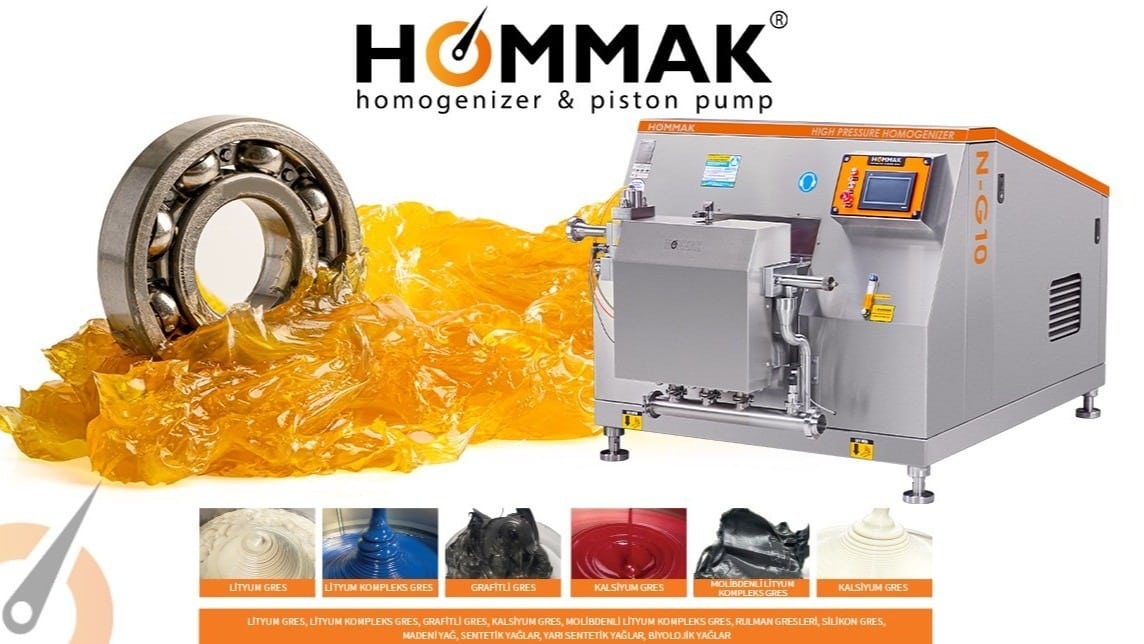

The high-pressure homogenizer has been standard equipment in the dairy sector for decades. On the grease side the technology sits in a relatively newer position; technical assessments aimed at the sector are still limited in the literature.
The field data we at Hommak have gathered from the dozens of homogenizers we have installed for grease manufacturers, together with the critical insights picked up at trade fairs and industry events, has brought to light many points within the microstructure–process–performance triangle that deserve discussion. The article below was written with the intention of sharing part of that accumulated experience on a technical footing.
Why Should We Care About Grease Microstructure?
When you examine a soap-based grease under a SEM (Scanning Electron Microscope), you see a three-dimensional network made up of interlocking fibers. This network holds the base oil through capillary forces. Grease is like a sponge. The skeleton of the sponge is the fiber network, and the liquid inside it is the base oil. The quality of this network determines the entire performance of the product.
1. The Difference Between a Homogeneous and a Heterogeneous Structure
If the fibers are coarse and heterogeneously distributed, some regions of the network hold too much oil while others release it. The result: oil bleeding in storage, unbalanced behavior under mechanical stress, and unpredictable performance for the end user.
If the fibers are homogeneously distributed and the agglomerates have been broken down, the network takes on a uniform structure. Oil is held in balance throughout the entire volume, and the product behaves consistently both in storage and in application.
This is precisely the function of the homogenizer: to optimize that geometry. And it does so at a level the older-generation colloid mills cannot reach.
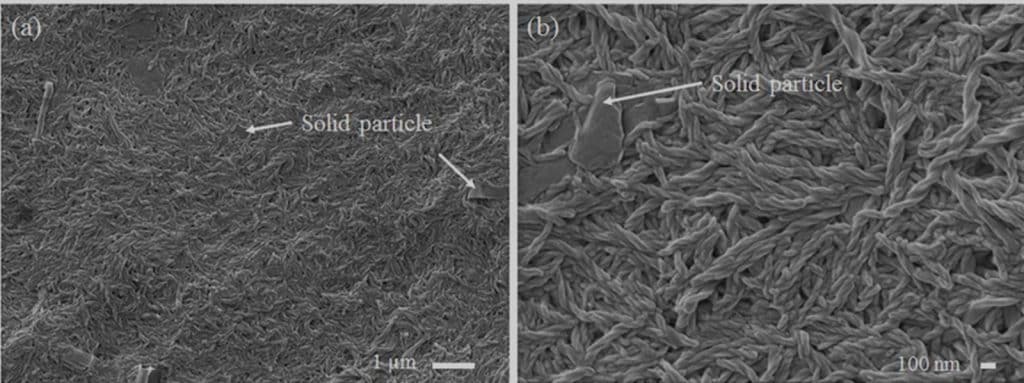
SEM Image
2. What Does a High-Pressure Homogenizer Physically Do?
The common sentence used to describe what a homogenizer does to the product is this: “You compress it at high pressure and push it through a valve.” True, but incomplete. During the passage through the valve more than one physical event comes into play simultaneously, and the real effect on the microstructure emerges from the combination of these events.
When the product approaches the homogenizing valve under high pressure, the pressure drops to almost atmospheric level within milliseconds as it passes through the valve. This sudden drop triggers four physical events at the same time.
A very high shear rate (far above that of classical mills), an impact effect dependent on valve geometry (mechanically breaking up agglomerates), cavitation (an energy density that penetrates all the way to the agglomerate cores through the collapse of micro-bubbles), and a turbulence effect (a secondary micro-mixing within the product).
When these four mechanisms work together, the effect on the microstructure clearly goes beyond the limits of classical mills. More importantly, all of this takes place in a single pass, inside a single valve, dependent on a single measurable parameter: pressure.
The practical benefit for the manufacturer begins here. The physical process that determines the microstructure now becomes tied to a parameter that can be controlled and repeated. In a colloid mill, rotor wear, gap setting and feed temperature are reflected in the result only indirectly, whereas in a homogenizer pressure is a variable that is directly measured and held constant.
3. Soap Efficiency and Penetration Control
The most fundamental parameter that gives grease its identity is penetration — it directly determines the product’s hardness, its structural character and ultimately its position in the market. The penetration value in turn depends on both the soap content and the microstructure.
Our field observation is that when the same formulation passes through a homogenizer, a lower penetration — that is, a firmer product — is obtained compared with a colloid mill. The reason lies in the microstructure. When the fiber network is better developed and homogeneous, the same amount of soap builds a much stronger structural skeleton; the product deforms less under mechanical stress.
For the manufacturer this has two practical consequences. First, the target penetration value can be reached with less soap. Soap is one of the most expensive main components in a grease formulation; a saving of a few points of soap is a direct gain in cost per ton. Being able to produce a product of the same hardness with a leaner formulation both lowers raw material cost and shortens the reaction time, improving the production cycle. Second, the penetration value is held within a far narrower band from batch to batch. Penetration that swings around the target value in the classical process is locked close to the target point and stays there with a homogenizer. This both allows product of constant character to be shipped to the customer and eases the quality control burden on formulations that sit near specification limits.
Reference: ASTM D217 (Cone Penetration of Lubricating Grease, Worked).
4. Mechanical Stability: The Measure of Long-Term Performance
Grease is continuously exposed to mechanical stress while in service. Its ability to withstand this stress is measured by ASTM D1831 (Roll Stability) or ASTM D217 (100,000 strokes) tests.
Mechanical stability depends on microstructure far more than on formulation. The same formulation can give different stability under different finishing conditions.
The fibers of a well-homogenized grease are already at an optimum micro size; mechanical stress cannot alter these fibers much. The product largely retains its penetration value throughout service. In a poorly homogenized one, agglomerates that were not broken down sufficiently break apart under mechanical stress and the product softens noticeably.
The feedback we receive in the field, particularly from manufacturers dealing with OEM approval processes, points in the same direction: in formulations where the penetration change after 100,000 strokes sits right at the final test threshold, a change made on the finishing line can very often correct the outcome without touching the formulation. Being able to improve a test result without intervening in the recipe significantly reduces both R&D time and the total cost of the approval process.
5. Deaeration: No Additional Process Required
During the grease production process the product inevitably takes in air during the mixing and transfer stages. This air is trapped in the form of micro-bubbles and creates three problems: volume differences in packaging, visual quality defects on the surface, and heat transfer problems in the bearing.
One of the most valuable effects of the homogenizer comes into play here. The product homogenized under high pressure completely loses the micro-bubbles inside it. The bubbles either dissolve or are carried to the surface and removed.
The practical meaning of this is: the product leaving the homogenizer does not need a separate deaeration step. In the classical process, vacuum deaeration requires an additional tank, an additional pump, an additional vacuum system and additional cycle time. The homogenizer removes this step on its own. In terms of capital investment, operating cost and total time in the production flow, this is a direct advantage that should be concretely calculated in the investment decision.
6. The “Higher Pressure, Better Grease” Fallacy
A frequently encountered assumption in the sector is that raising the homogenization pressure as far as possible will improve product quality. The data does not support this.
Every formulation has an optimum processing pressure. Below it, the microstructure is not sufficiently optimized. Above it, something interesting happens: the fiber network is over-fragmented, the fibers fall below the critical length, and the capacity of the capillary forces to hold the oil declines. In other words, excessive homogenization can paradoxically increase the oil bleeding problem.
The correct pressure for a lithium EP2 may not be correct for a polyurea. A different threshold applies to a calcium sulfonate complex.
A similar emphasis has come to the fore in the conversations we have had at recent ELGI (European Lubricating Grease Institute) events: the sector is maturing away from positioning homogenization pressure as a fixed “value” and toward an approach of determining the optimum threshold specific to each formulation. The impression we have gained at fairs and technical sessions points the same way; a significant proportion of professionals now focus on the question of “how correct” rather than “how high”.
For this reason it is critical that the optimum pressure be determined before moving to industrial production. This is where laboratory-type homogenizers come in. Recipe studies can be carried out at different pressure levels with small-volume samples; the relationship between formulation, microstructure and pressure can be clearly characterized before scaling up to production. Because homogenization principles are largely independent of scale, the optimum pressure value obtained on the laboratory device can be transferred directly to the industrial homogenizer. This both shortens R&D time and significantly reduces the surprises that can arise when new products move into production.
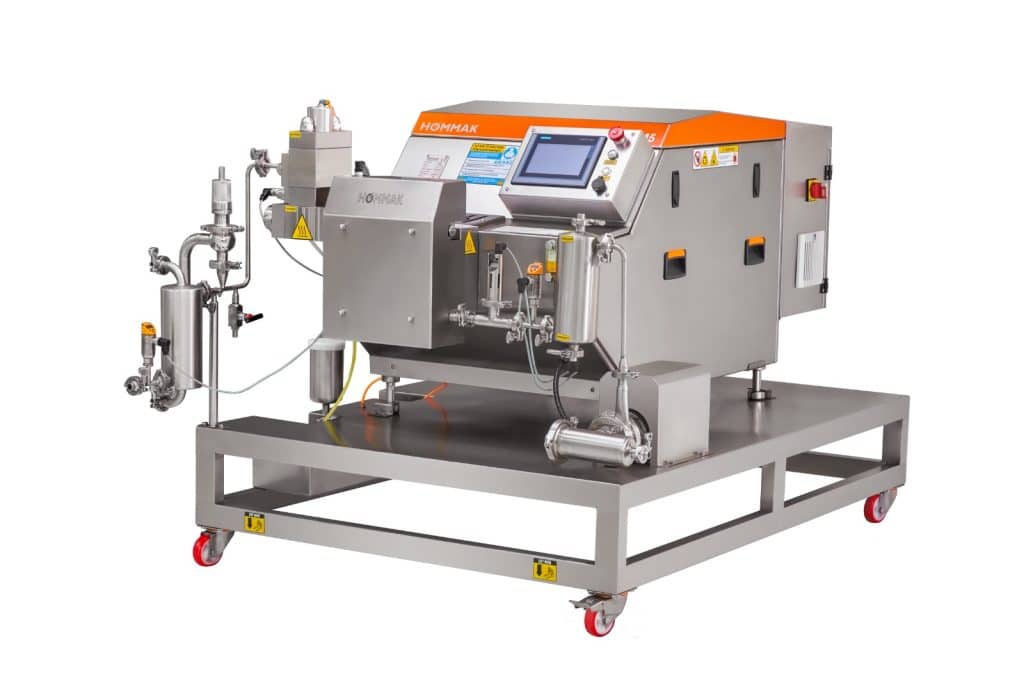
Laboratory-Type Grease Homogenizer
7. The Agglomerate Problem
The surface of a grease may look homogeneous to the naked eye. Under the microscope, however, small agglomerate clusters may be present within the product. These agglomerates are fiber clusters that have not been fully broken down, or lumps of additive.
The most pronounced contribution of the homogenizer’s cavitation and impact effect emerges here. These two mechanisms break down not just the outer layer of the agglomerates but their volume all the way to the core. Classical mills may erode the outer layer of an agglomerate while leaving the inner core intact. In a grease produced with a homogenizer this inner core is dispersed as well, and the product displays fully homogeneous behavior in both storage and field performance.
The practical result: the solution to storage complaints caused by agglomerates most often lies not in the formulation but in the finishing process. Carrying out a microscopic analysis before intervening in the formulation of a product that has drawn complaints is critically important for a correct diagnosis.
8. Additive Dispersion and Formulation Efficiency
Modern greases no longer consist only of soap and base oil. They contain EP additives, antioxidants, corrosion inhibitors, friction modifiers and solid lubricants (graphite, MoS₂, PTFE).
So are these additives really distributed homogeneously at the micro scale?
Simple mixing distributes additives at the macro scale but does not achieve dispersion at the micro scale. Solid additives in particular tend to agglomerate and are difficult to detect in standard quality control. This is directly reflected in product performance.
The homogenizer disperses additives into the matrix at the micro scale. This has two consequences.
First, the effectiveness of the additive increases. The same amount of EP additive delivers higher performance. This creates a direct saving opportunity in formulation costs, because additives are more expensive than base oil. The manufacturer can maintain the same performance with less additive, or target higher performance with the existing additive quantity.
Second, product stability increases. Because homogeneously dispersed additives are consumed in a balanced way throughout the volume, they sustain their protective function at a steady level over the life of the grease. Agglomerated additives, on the other hand, provide dense protection in the region where they initially sit; but the additive is depleted in that region within a short time, and the rest of the matrix is left unprotected at the very moment the real performance need arises.
In greases containing solid lubricants this effect is even more pronounced. Graphite or MoS₂ particles are not merely ground; they are distributed into every cubic micron of the matrix. This is what determines real performance in the bearing.
9. Oil Bleeding Control
The fiber network of a well-homogenized grease offers a uniform capillary structure; the oil is held in balance and released in a controlled way only under mechanical stress. In a heterogeneous network, oil cannot be held sufficiently by capillary forces in the sparse regions and comes to the surface during storage.
This condition, known in the sector as “syneresis”, is often attributed to the formulation. Analytically, however, the real cause is usually the non-homogeneity of the microstructure. The homogenizer keeps oil distribution in balance by ensuring the capillary structure forms uniformly throughout the volume. As a reference, ASTM D6184 (Oil Separation from Lubricating Grease) provides the standard method for this assessment.
10. Batch-to-Batch Consistency
The customer does not buy the product’s properties; the customer buys its consistency.
In a homogenizer, pressure is constant and continuous. When constant pressure, constant flow rate and constant temperature are supplied, the product is subjected to the same homogenization in every batch. Variation between batches stays within a narrow band. This both reduces customer complaints and lowers quality control cost, because verifying the output of a consistent process requires far less testing than verifying the output of a fluctuating one.
One of the sentences most often repeated to us over decades of working with the sector’s leading manufacturers is this: “Making the best version of a product once is not difficult; making the same one in every batch is.” The product’s peak performance already comes out of the formulation; but reproducing that peak performance at the same level in every batch, on every shift, with every operator is an entirely different piece of engineering — and the homogenizer is a device designed precisely to solve that problem.
11. Overall Assessment
To summarize the advantages a high-pressure homogenizer provides in grease production in technical terms: a level of control over microstructure that mills cannot reach, a breaking effect that penetrates all the way to the agglomerate cores, homogeneous dispersion of additives at the micro scale, oil bleeding brought under control as the capillary structure becomes uniform, no need for a separate deaeration, repeatability tied to a measurable parameter (pressure), and the ability to move directly from the laboratory to industrial production.
The homogenizer has now become not a preference in the sector but a mature standard. The colloid mill served its function in its own era; but today it cannot meet the level of performance, consistency and microstructure control the grease market expects. The trend we also see from our experience in the sector is this: serious manufacturers are setting their mills aside and building their finishing lines around the homogenizer. The reason is simple — the microstructure quality of the product obtained with a homogenizer has become the new reference point for the market’s upper segment.
A good formulation can turn into an average product without the right process. And this is exactly where the real value of the homogenizer in grease production emerges: bringing out the full potential of the formulation and making the product the best in its class.
References
- Lugt, P. M. (2013). Grease Lubrication in Rolling Bearings. Wiley Tribology Series. John Wiley & Sons.
- Rudnick, L. R. (Ed.). (2017). Lubricant Additives: Chemistry and Applications (3rd ed.). CRC Press.
- ELGI AGM (European Lubricating Grease Institute) — Personal notes from Annual General Meetings.
The use of a high-pressure homogenizer in grease production goes beyond simply obtaining a more homogeneous product; it offers a significant advantage in terms of microstructure control, batch consistency, additive efficiency and optimization of the production process. Determining the correct homogenization pressure for your formulation and selecting equipment suited to the needs of your existing production line directly affects the real performance of the investment.
Contact us to evaluate the advantages homogenizer technology can bring to your grease production process and to determine the right solution for your application.