Use of High Pressure Homogenization (HPH) to Control Phase Separation in HPP-Treated Natural Fruit Juices
1. Executive Summary
This report evaluates the feasibility and technical rationale of using High Pressure Homogenization (HPH) to solve phase separation (cloud instability) issues observed in natural fruit juices processed with High Pressure Processing (HPP).
The specific case considered is a natural fruit juice with a 2‑month microbiological shelf life, where visible phase separation occurs between 2 and 14 days, leading to unacceptable product quality.
Based on scientific literature, processing mechanisms, and industrial practice, this report concludes that HPH operated at 400 bar (40 MPa) can significantly delay or eliminate phase separation by improving physical stability, even when HPP is already applied.
2. Background: The Problem with HPP‑Only Processing (6000 Bar)
High Pressure Processing (HPP) is highly effective for:
Microbial inactivation
Shelf‑life extension
Preservation of fresh‑like sensory attributes
However, HPP does NOT address physical instability, because:
It does not reduce particle size
It does not homogenize suspended solids
It may even release cell wall fragments that accelerate sedimentation
As a result, many HPP‑treated fruit juices become:
Microbiologically stable but physically unstable
This explains why the product remains safe for 2 months but becomes visually unacceptable within days or weeks.
3. Root Causes of Phase Separation in Natural Fruit Juices
Phase separation in cloudy or pulpy juices is primarily caused by:
- Large and non‑uniform particle size distribution (>10–20 µm)
- Cell wall fragments and pulp agglomerates
- Pectin–protein imbalance
- Density differences between liquid and suspended solids
When gravity exceeds Brownian motion, sedimentation and phase separation occur.
4. What High Pressure Homogenization (HPH) Does
High Pressure Homogenization forces the juice through a narrow homogenizing valve at high velocity, generating:
- Intense shear forces
- Turbulence
- Cavitation
At 400 bar, these forces are sufficient to:
- Break down pulp and fiber aggregates
- Reduce average particle size
- Narrow particle size distribution
- Improve dispersion of insoluble solids
The result is a physically stable suspension with significantly reduced sedimentation velocity.
5. Why 400 Bar Is a Realistic and Effective Pressure Level
While academic studies often report pressures of 100–150 MPa, these values are used to demonstrate maximum effects under laboratory conditions.
In industrial continuous production, equivalent functional stability can be achieved at much lower pressures by optimizing:
- Pressure
- Number of passes
- Product temperature
400 bar (40 MPa) represents:
- A proven industrial homogenization level
- Low mechanical and thermal stress on the product
- High equipment durability and energy efficiency
At this pressure, significant improvement in cloud stability has been demonstrated for fruit juices, especially when phase separation occurs within days.
6. Expected Impact of using Homogenizer at 400 Bar
6.1 Physical Stability
- Significant reduction in particle size
- Slower sedimentation rate
- Extended cloud stability throughout the intended shelf life
6.2 Shelf Life Quality
- Phase separation delayed from 2–14 days to several weeks or full shelf life
- Consistent appearance without shaking
- Improved consumer perception of quality
6.3 Sensory and Nutritional Integrity
- Minimal temperature rise
- No cooking effect
- Fresh‑like taste and color preserved
7. Integration of HPH with Existing HPP Process
HPH should be positioned before HPP, as shown below:
- Juice extraction
- Filtration / coarse screening
- High Pressure Homogenization – 400 bar (1–2 passes)
- Filling
- High Pressure Processing (HPP)
- Cold storage and distribution
This sequence ensures:
- Physical stabilization before packaging
- Microbiological safety after packaging
8. Recommended Processing Parameters (Initial Trials)
| Parameter | Recommendation |
| Homogenization pressure | 400 bar |
| Number of passes | 1 (up to 2 if required) |
| Inlet temperature | < 25 °C |
| Product type | Cloudy / pulpy fruit juice |
| Storage test | 2 days – 14 days – 2 months |
9. Limitations and Considerations
While HPH at 400 bar is highly effective, the following should be evaluated during pilot trials:
- Pectin content and enzymatic activity
- Very high pulp content products may require 2 passes
- Extremely clear juices may show limited visual benefit
HPH is not a stabilizer replacement but a mechanical stabilization technology.
10. Conclusion
Yes — phase separation in HPP-treated natural fruit juices can be effectively
controlled using a High Pressure Homogenizer operating at 400 bar.
By reducing particle size and improving dispersion, HPH addresses the physical instability
that HPP alone cannot solve.
For producers facing early phase separation despite long microbiological shelf life, HPH is a
logical, technically sound, and industrially proven solution.
The use of homogenizers supports the production of natural fruit juice without the need for stabilizer addition, or by minimizing its use.
11. Commercial Perspective
From a production and quality standpoint, the combination of HPH + HPP provides:
- Longer visual shelf life
- Higher product consistency
- Reduced customer complaints
- Strong differentiation in premium juice markets
This makes HPH not only a technical improvement, but also a strategic investment.
Some of the Juice/Aroma References;
DİMES GIDA SAN. VE TİC . AŞ.
DOEHLER
IFF
TASTE POINT
PRESAD
NARSU İÇEÇEK AŞ.
MARNOOR S.A.R.L
MARVEL JUICE CO. FOREIGN ENTERPRISE JSC
JSC EURASİAN ALCOHOL GROUP
AL MAZAQ AL MOMAYEZ COMPANY
BOYRAZOĞLU TARIM TİC. SAN. LTD. ŞTİ.
EGYPTIAN SUGAR & INTEGRATED INDUSTRIES
Siam Ocean for food Industries
LEVANT BEVERAGE &DAIRY INDUSTRIES SAL
FERNAS GIDA
MERCURY – PROIZVODSTVIENNYY
AL SAKR FOR FOOD INDUSTRIES S.A.E
GOLD FLOWER KİM.LTD.ŞTİ
MEYKON MEYVE SULARI VE KAYNAK SULARİ SAN. VE TİC. A.Ş
ECO FRUITS
PANAGRO GIDA -TORKU
STE ASSAVA POUR LE COMMERCE ET
GULF FOOD PRODUCTON DOHA
YUMMY MEYVE SULARI A.Ş.
ELİTE NATUREL
PROFRUIT MACHINERY
Validation Trials – Natural Orange Juice (No Additives, No Heat Treatment)
In addition to the technical evaluation above, practical validation trials were conducted using
100% natural orange juice.
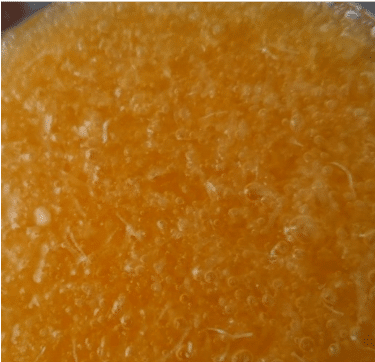
The primary objective of these trials was to prevent phase separation in fresh orange juice without the use of any additives, stabilizers, enzymes, or thermal treatment, and solely by applying High Pressure Homogenization (HPH).
The trials were designed to demonstrate that mechanical stabilization through HPH can effectively control cloud instability in untreated natural juice.
Trial Objective
- Use fresh natural orange juice
- No stabilizers or hydrocolloids added
- No pasteurization or thermal processing applied
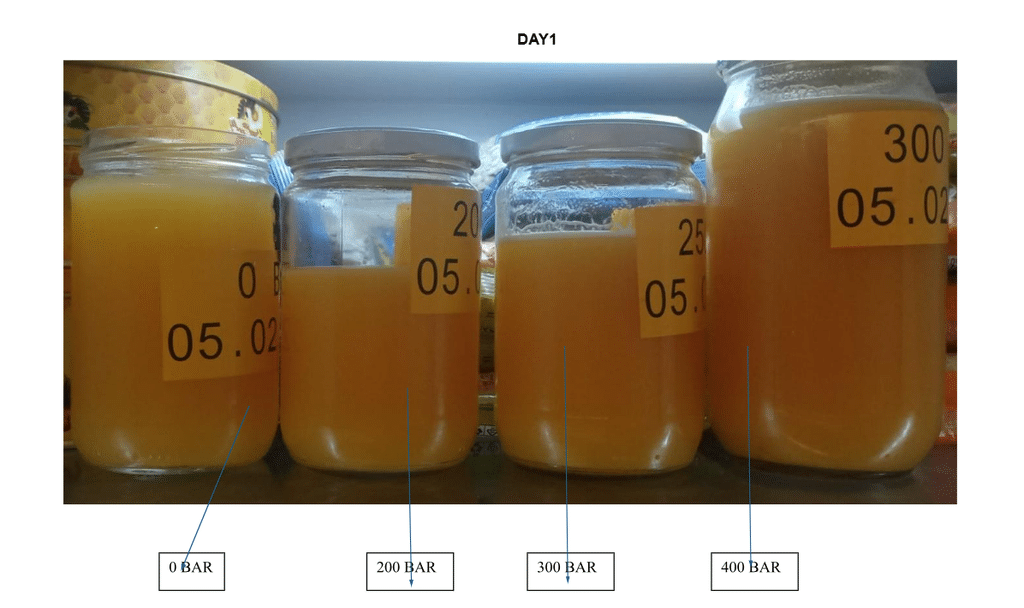
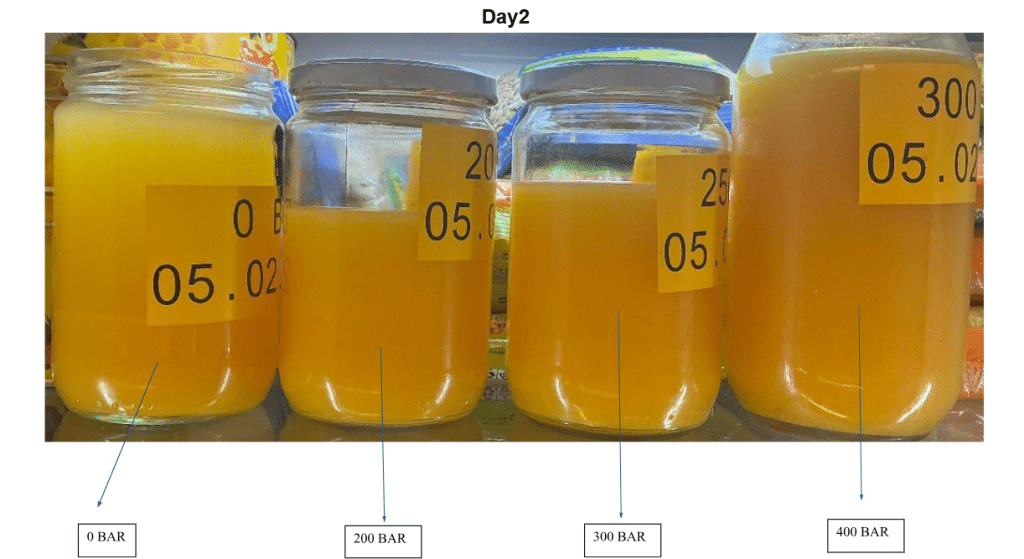
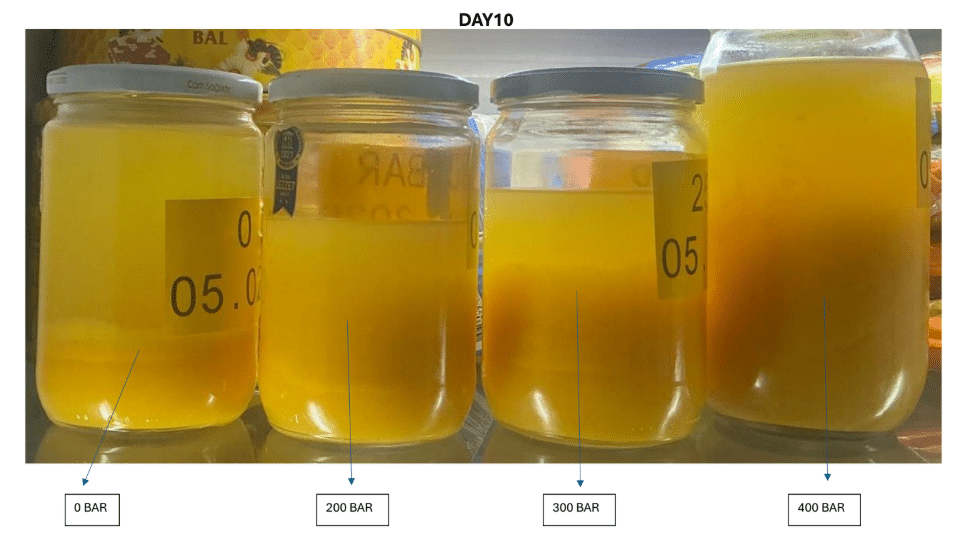
- Apply High Pressure Homogenization at 200/300/400 bar
- Monitor physical stability over time
Processing Conditions
- Product: 100% Natural Orange Juice
- Homogenization Pressure: 200/300/400 bar
- Number of Passes: 1
- Inlet Temperature : 18 °C
- Outlet Temperature : ≤ 25 °C
- No heat treatment before or after homogenization
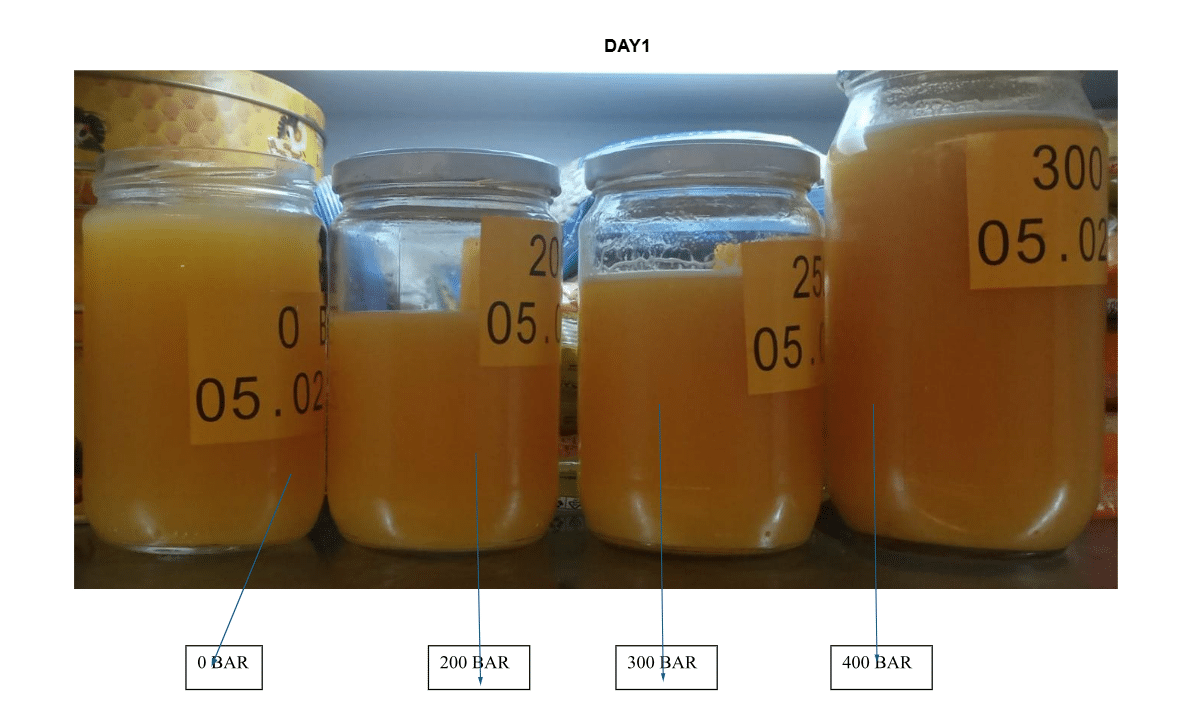
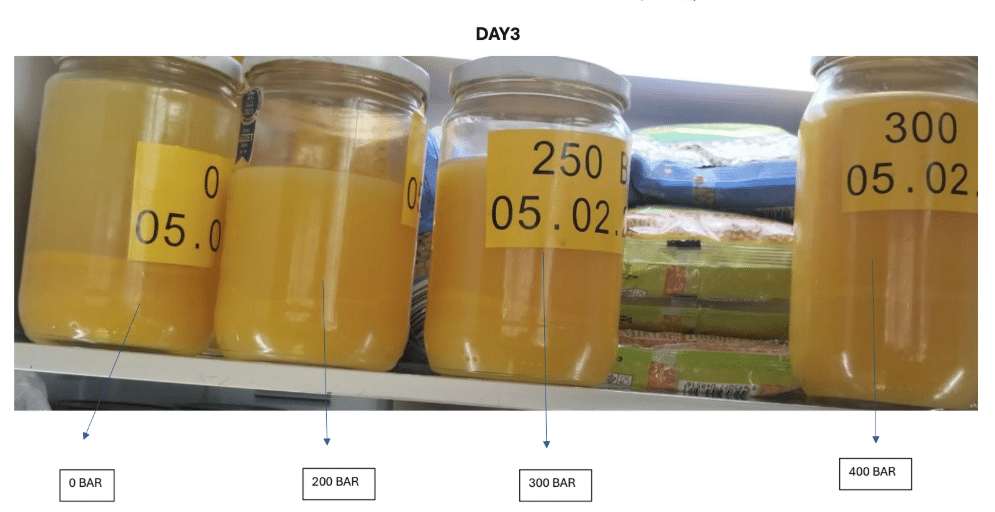
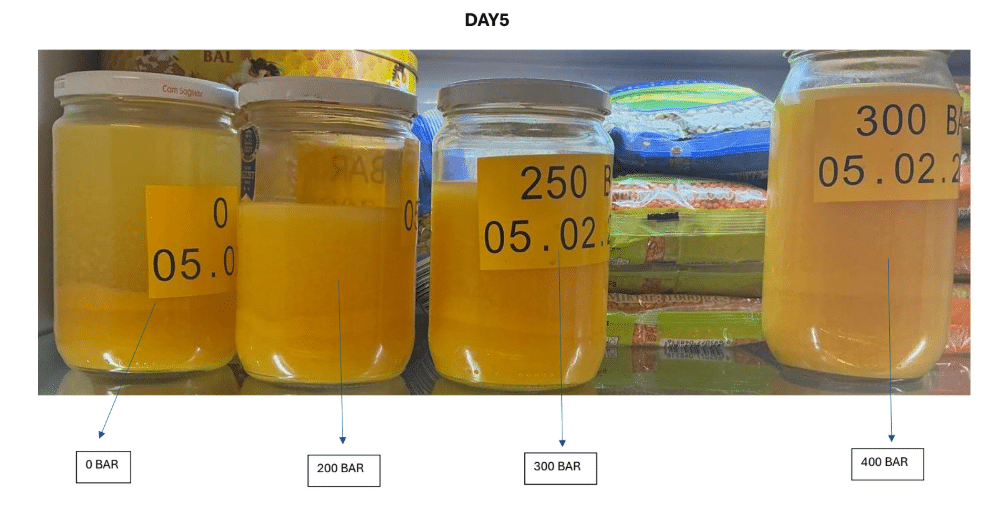
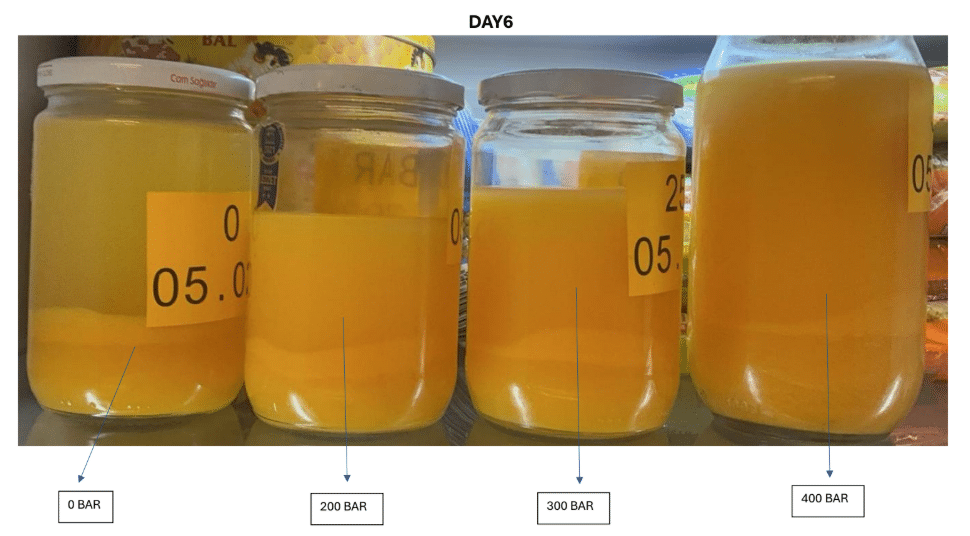
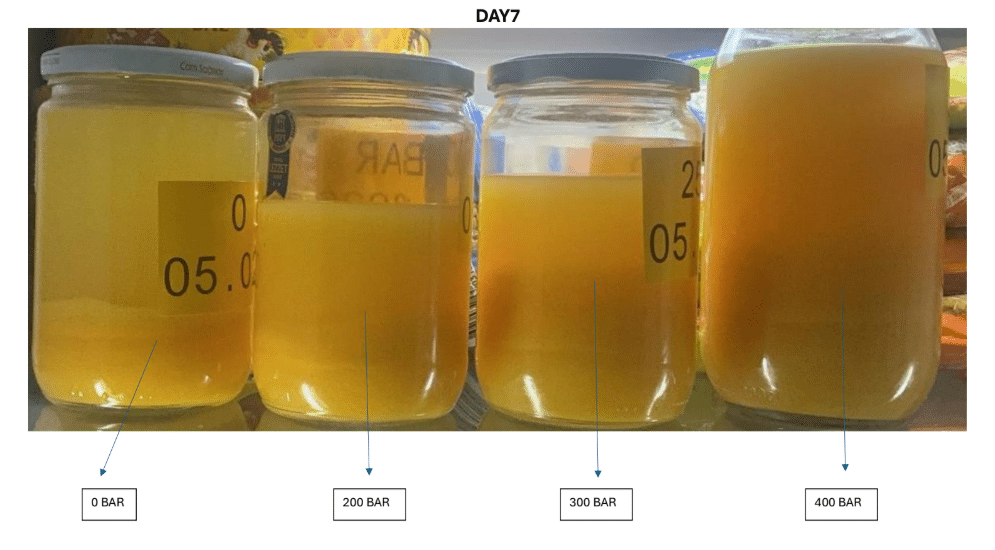
Observations and Daily Monitoring
The product was monitored visually on a daily basis to evaluate:
- Phase separation
- Sedimentation rate
- Serum layer formation
- Cloud stability
- Overall visual acceptability
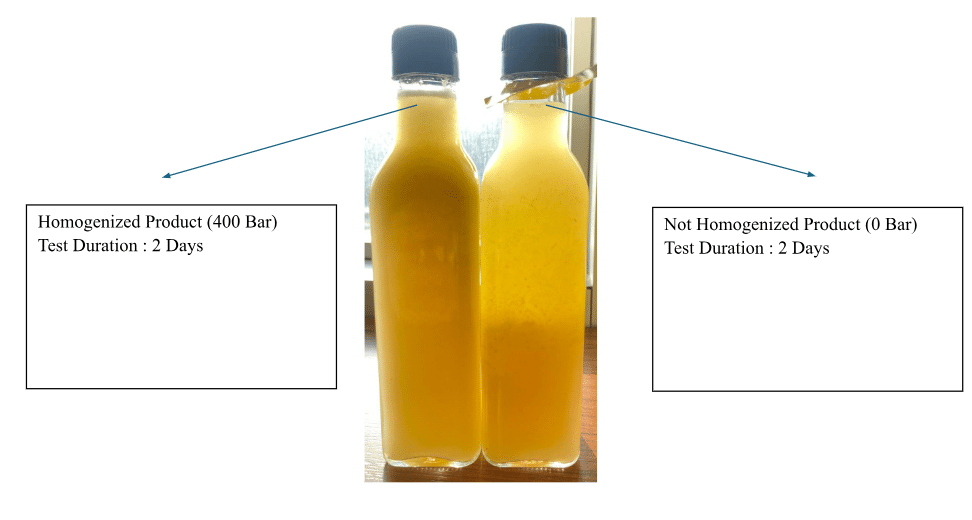
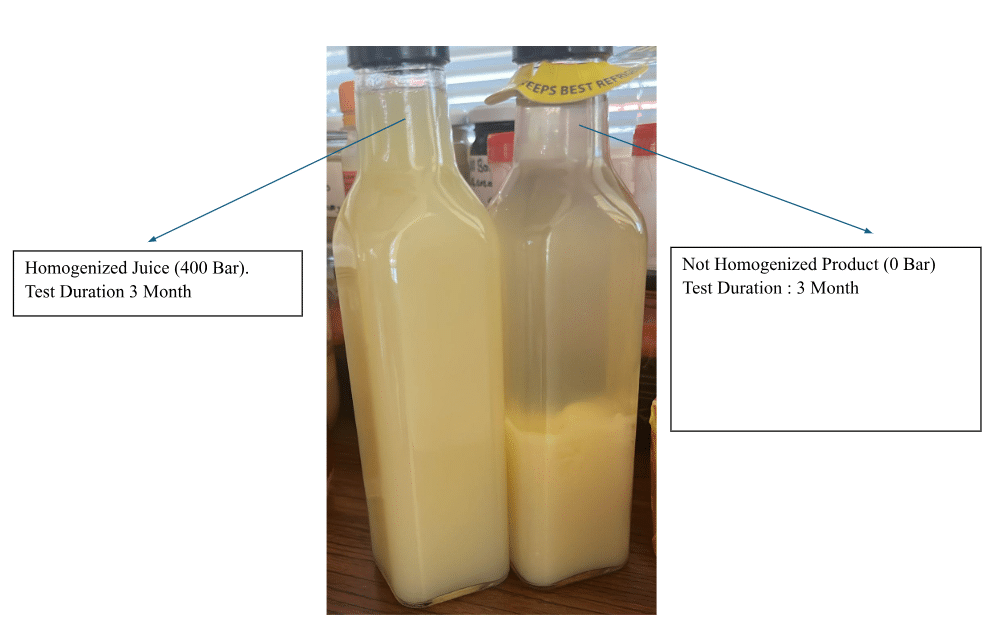
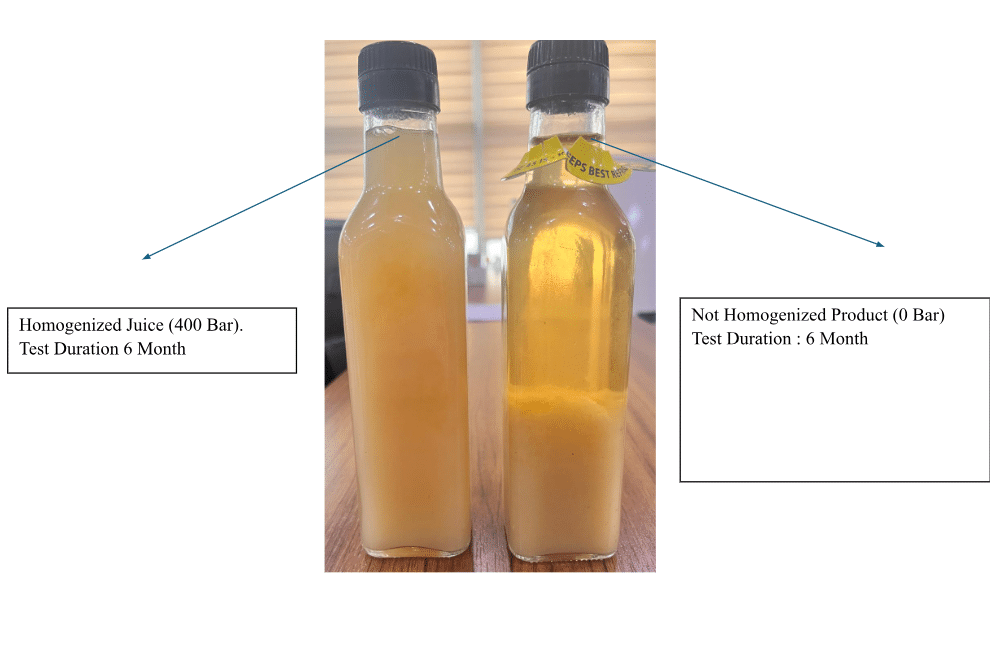
Comparative observations between untreated juice and HPH-treated juice showed:
- Significant reduction in pulp sedimentation
- More uniform particle distribution
- Improved suspension stability
- Delayed or eliminated visible phase separation
The daily changes in product appearance are documented and supported by visual records, clearly demonstrating the stabilization effect achieved through High Pressure Homogenization alone.
Technical Interpretation
The results confirm that:
- Mechanical particle size reduction alone can substantially improve physical stability.
- Additive-free stabilization of natural orange juice is technically feasible.
- HPH at 400 bar provides most sufficient shear forces to disrupt pulp aggregates and reduce sedimentation velocity.
- The product retains its fresh-like characteristics due to the absence of thermal stress.
These validation trials reinforce the conclusion that High Pressure Homogenization is an effective and practical solution for controlling phase separation in natural fruit juices, even when no chemical or thermal stabilization methods are applied.
To solve phase separation issues in HPP-treated natural fruit juices and ensure excellent physical stability throughout an extended shelf life, our high-pressure homogenizers offer one of the most effective solutions.
Contact us today to evaluate the advantages of homogenizer technology for your fruit juice production process and determine the most suitable solution for your product and production line.