How to Prevent Sedimentation and Gelation in High-Protein Beverages
A protein drink that came out perfect in the lab can, after passing through the UHT line and sitting on the shelf for three weeks, turn into a product with sediment at the bottom of the bottle, a fat ring on top, or complete gelation. That is why protein drink production is as much a process job as a formulation job: how the powder is dissolved, at what pressure it is homogenized and at which point heat treatment is done decide the result.
In this article we explain why sedimentation and gelation occur, which of them homogenization solves and which it does not, and the right process order. For the general mechanism of phase separation, see also our article on how to prevent phase separation .
Three different problems, three different causes
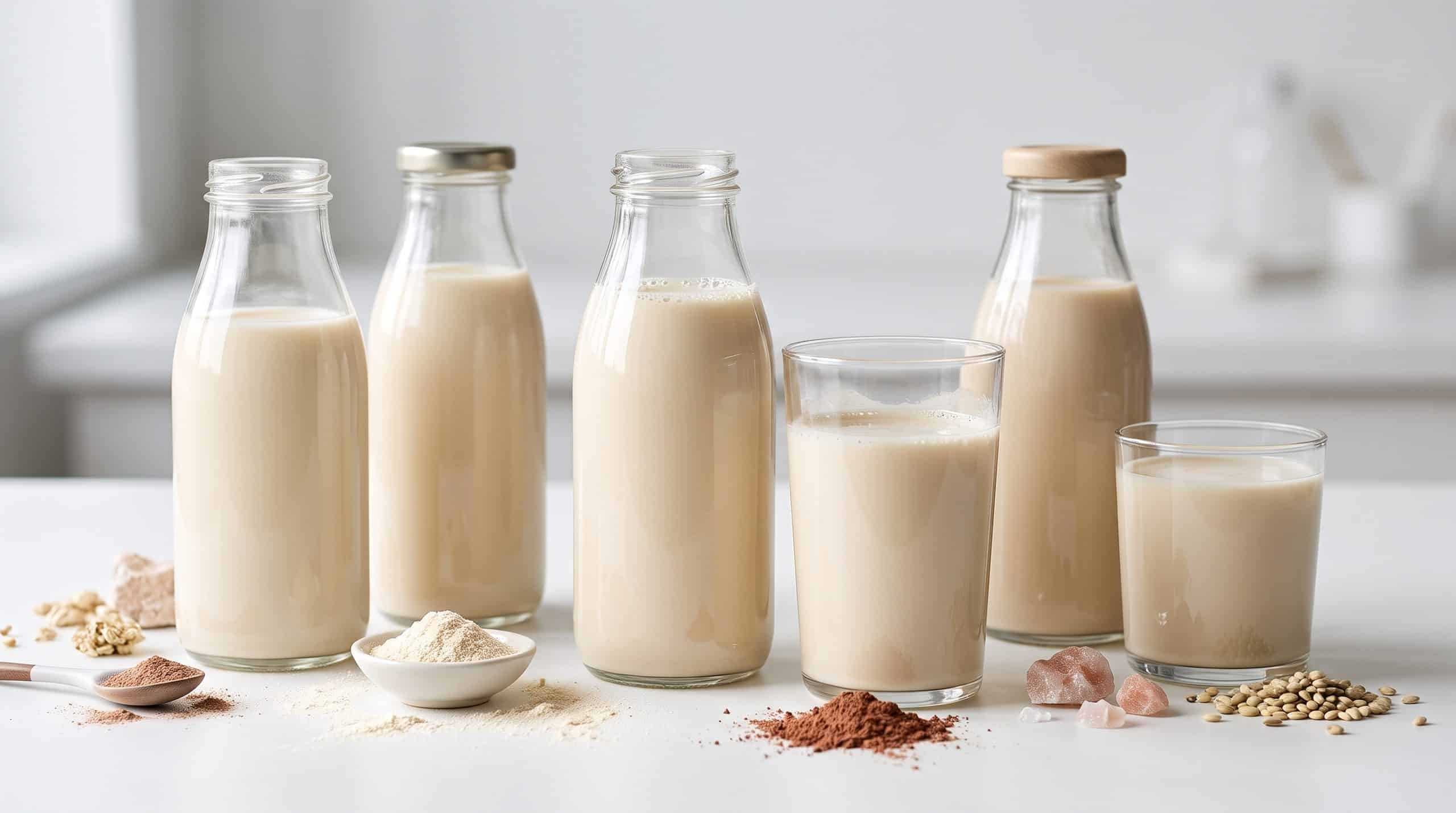
When people say “the protein drink has spoiled”, they actually mean three quite different defects:
| Defect | Appearance | Typical cause |
|---|---|---|
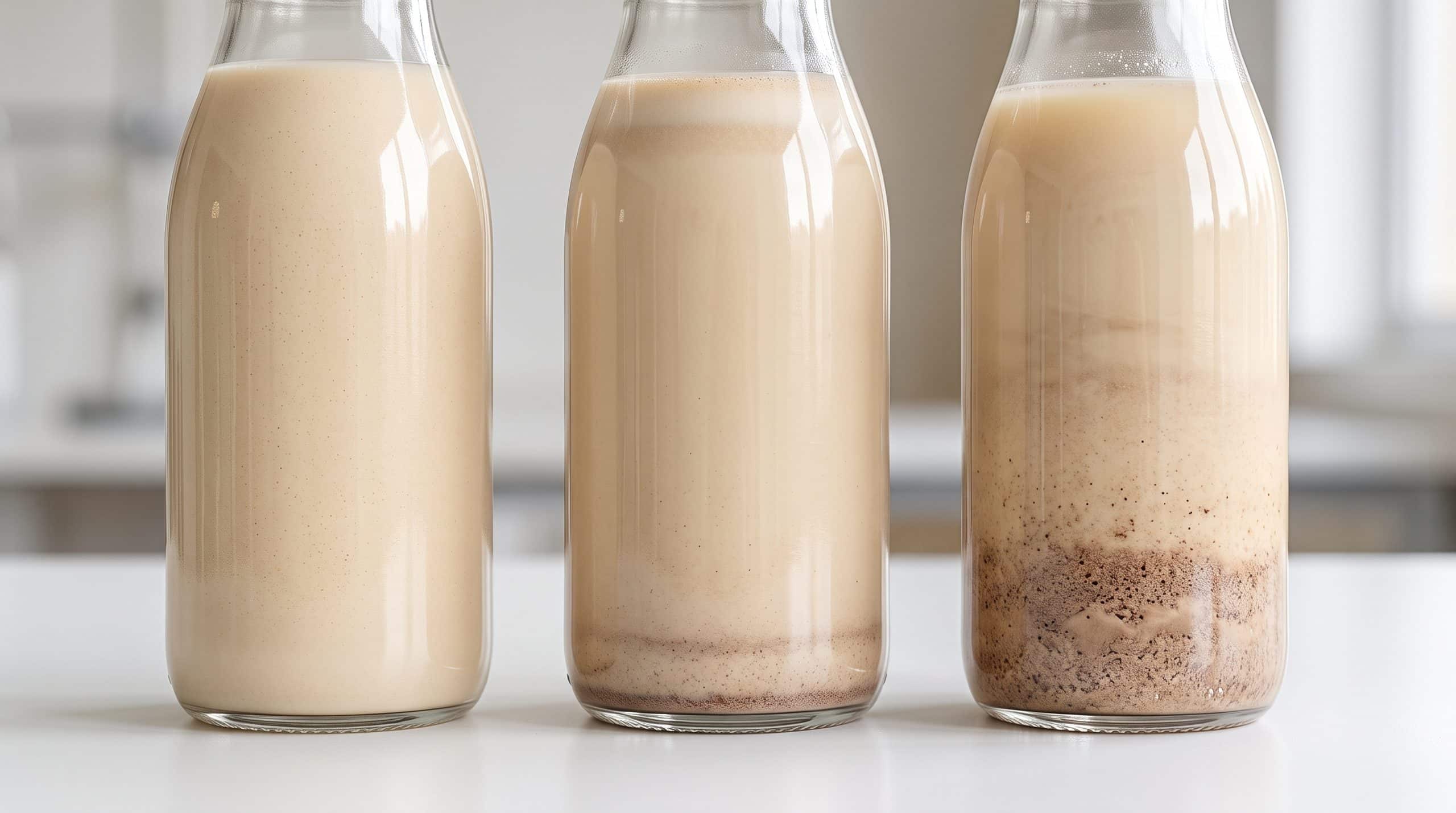
| Sedimentation | Deposit at the bottom of the bottle, disperses when shaken | Undissolved or coarse protein aggregates, mineral-protein complexes, cocoa and calcium salts |
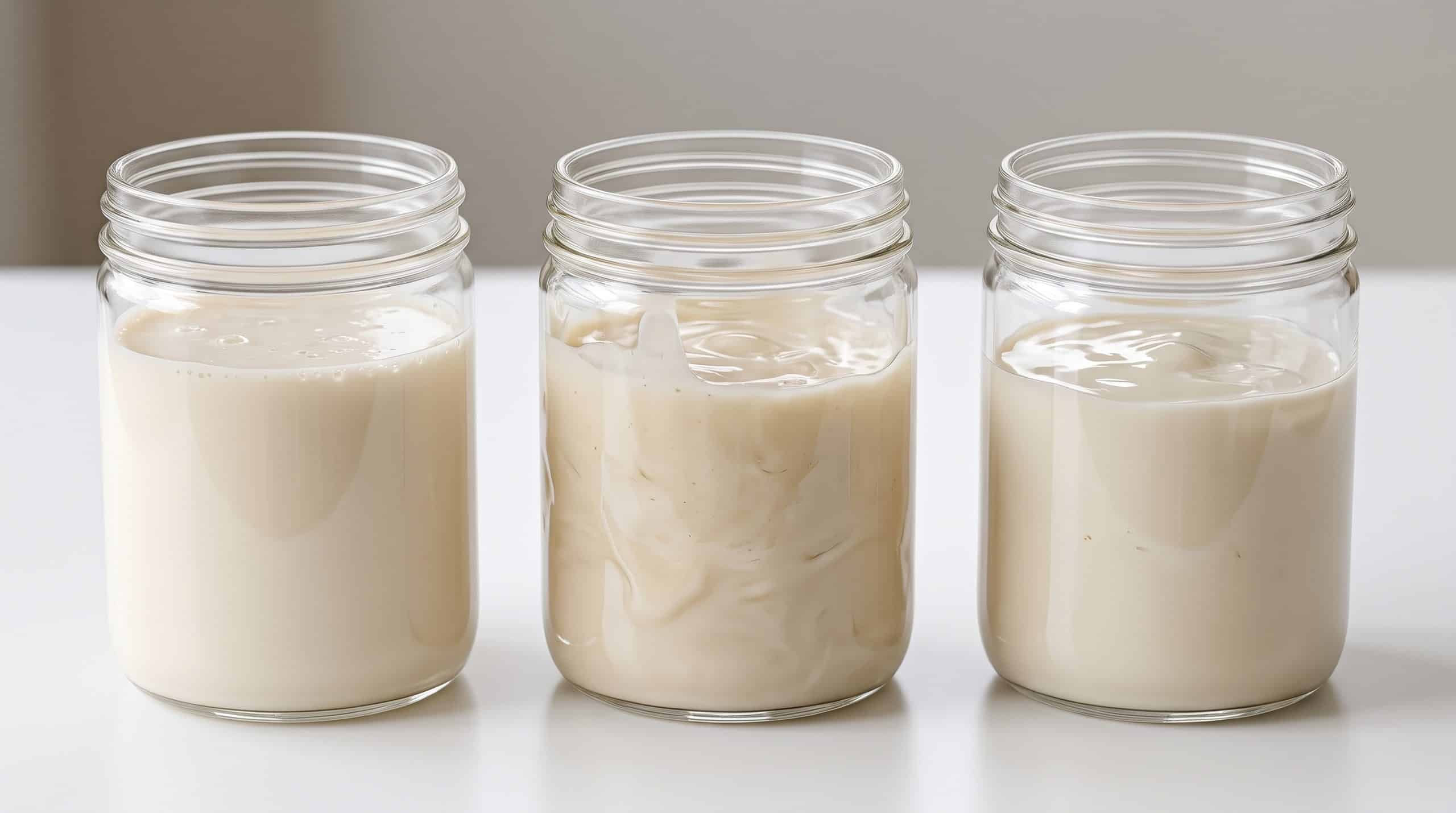
| Gelation | The drink thickens, reaches yogurt consistency | Whey protein aggregation during heat treatment, high protein concentration, enzyme activity in storage |
| Fat separation | Cream or a fat ring on top | Insufficient homogenization, lack of emulsifier |
The solutions to these three defects are different. Homogenization solves the third directly, plays an important role in the first, and on its own is often not enough for the second. Knowing this from the start saves you from blaming the wrong problem on the wrong machine.
The protein source determines behavior
Even at the same protein content, the protein used behaves very differently:
- Whey protein. Heat-sensitive. Whey proteins begin to denature above about 65-70 °C. At neutral pH and high concentration there is a risk of aggregation and gelation during UHT.
- Casein or caseinate, micellar casein. Resistant to heat treatment, but viscosity rises quickly at high concentration.
- Milk protein concentrate (MPC). A mixture of casein and whey protein; it can carry the problems of both.
- Plant protein (pea, soy). Low solubility, coarse particles, high tendency to settle.
At the formulation stage this choice largely determines which process route will work.
The right process order
Most successful protein drink lines follow this order:
- Powder dispersion and hydration. The protein powder is added to water without lumps using a high-shear mixer. For hydration it is usually held for 30-60 minutes at 40-50 °C. Moving to heat treatment before hydration is complete traps undissolved aggregates in the product.
- Deaeration. Foam and air cause problems both in the homogenizer and in the subsequent heat treatment.
- Homogenization. Applied in two stages in a total range of 150-250 bar (for example 150/50 bar). In formulations containing fat, the fat globules are reduced and hydrated protein clusters are broken up.
- Heat treatment. UHT or retort.
- Second homogenization if needed. After heat treatment, with an aseptic-type machine, used to break up clusters. Because it enlarges the line and the investment, it is preferred only for the products that need it.
At the dispersion stage, high-shear mixers are used, and in in-line solutions the MicroMix in-line mixer ; the high-pressure homogenizer does not replace this step, it comes into play after it.
What does homogenization solve and what does it not?
The homogenizer reduces coarse particles and aggregates through cavitation, shear and impact in the valve gap. This gives the following results:
- Hydrated but clustered protein pieces are dispersed.
- Fat globules are reduced and creaming decreases.
- Cocoa, minerals and similar solid particles are distributed more finely and evenly; together with the stabilizer this increases suspension stability.
But homogenization does not do the following:
- It does not remove chemical instability. If the pH, calcium and other mineral balance are not suitable, the protein will still settle after homogenization.
- It does not reverse heat denaturation. If whey protein aggregates with heat, you have to solve that with formulation (pH, minerals, stabilizer) and heat treatment settings.
- It does not prevent enzymatic gelation that develops during storage (caused by residual protease activity).
Excessive homogenization also has a cost. When the surface area increases too much, viscosity can rise, especially in high-protein systems. That is why particle size should be measured and the effect weighed before pressure is increased.
Formulation settings must be considered together with homogenization
However good the homogenizer, the result will not improve if the following items are wrong:
- pH. Casein-based drinks work near neutral pH (6.8-7.2). In clear acidic whey drinks the pH is generally in the 3.2-3.8 range. A pH close to the isoelectric point of the protein means sedimentation.
- Mineral balance. Calcium and magnesium precipitate protein. The use of sequestrants and water quality are therefore important.
- Stabilizer. Low-acyl gellan, MCC/CMC or carrageenan physically hold the suspension. Homogenization gives fine particles; the stabilizer keeps those particles suspended.
- Hydration time and temperature. A shortened hydration comes back later as aggregates that do not dissolve.
Troubleshooting table
| Observation | Check first | Then |
|---|---|---|
| Sediment coming from the powder | Hydration time, powder dispersion | Homogenization pressure and stage |
| Thickening after UHT | pH, mineral balance, protein type | Heat treatment profile, aseptic homogenization |
| Gelation after weeks | Enzyme activity in the raw material, storage temperature | Heat treatment intensity |
| Fat ring | Homogenization pressure, temperature, valve condition | Emulsifier level |
| Cocoa settling | Stabilizer | Particle size, homogenization |
| Viscosity too high | Hydration time, excessive homogenization | Protein content, temperature |
Validate in a pilot first
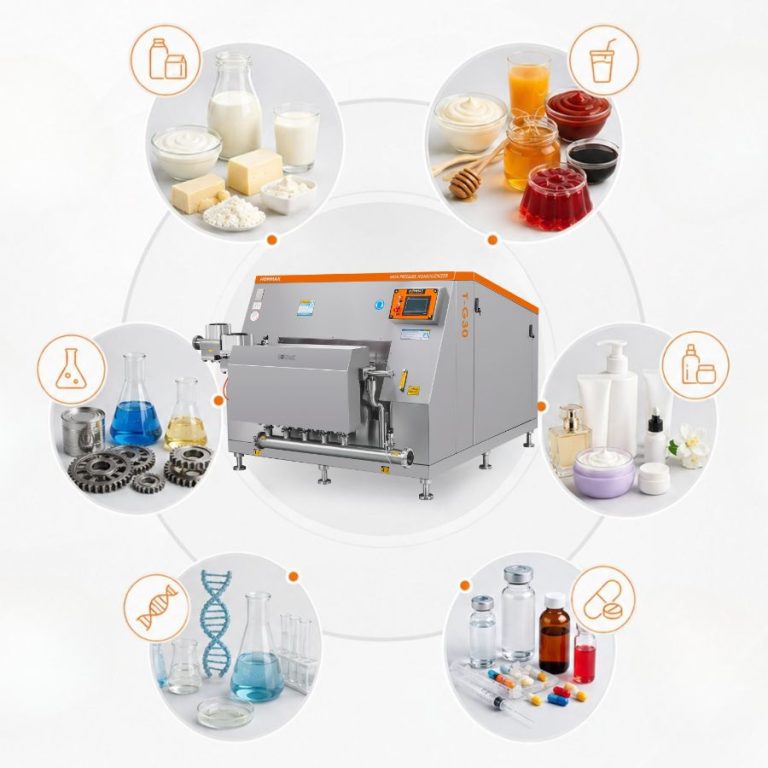
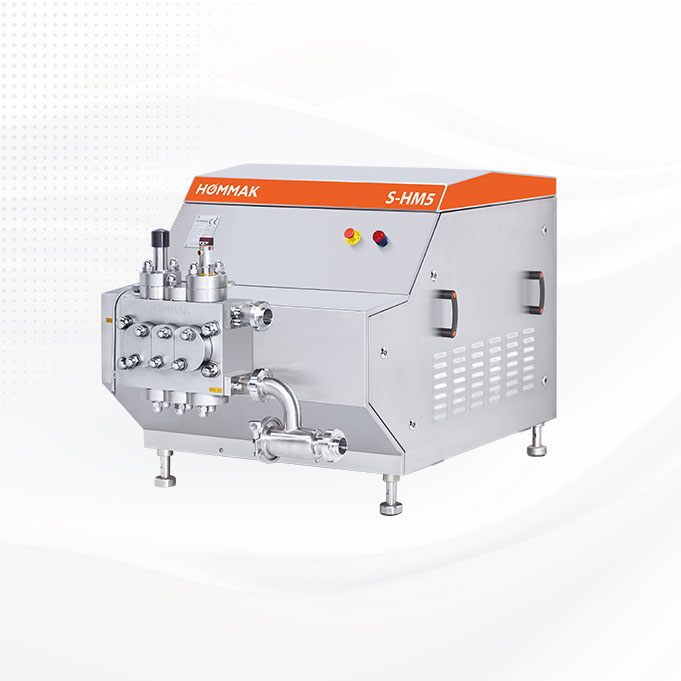
Changing the recipe and trialing it on the line is expensive for protein drinks. It makes sense to validate pressure and stage settings at small scale first, using small-volume laboratory and pilot homogenizers. HOMMAK’s pilot and laboratory-type S-HM5 model gives 100-125 liters per hour at 1,000 bar, and the C-HM1 model 60 liters per hour at 400 bar (catalog values). There are two things you will measure here: particle size distribution by laser diffraction, and stability after accelerated storage (for example several weeks at 30-40 °C).
When you then move to the industrial line, scaling is done on the same pressure and stage values. To choose industrial capacity, you can look at the high-pressure homogenizer models and our food and beverage application page.
What to look at when choosing a machine
- Feed viscosity. High-protein mixtures are viscous; if there is not enough pressure at the pump suction, cavitation starts. This shortens piston and valve life.
- Abrasive content. Mineral, cocoa or plant protein particles can increase valve wear; the valve material should be chosen accordingly.
- Hygiene and CIP. Protein products stick to the line. The CIP program and a design without dead volume are important.
- Capacity. The nominal flow rate of the line should be the basis, and future product varieties should be considered.
Five control points to monitor in production
In protein drinks the problem usually comes not from a single setting but from drift in one link of the chain. What must be monitored continuously on the line:
- Hydration time and temperature. After the protein powder is added to water, enough waiting time is needed for full dissolution. A mixture sent hurriedly to the homogenizer carries undissolved lumps to the valve.
- pH. Whey protein is clear and stable in the acidic range and sensitive to heat treatment at neutral pH. In casein-based products, approaching the isoelectric point (about pH 4.6) increases sedimentation. The formulation’s pH window should be kept narrow.
- Heat treatment intensity. Every extra degree and second increases whey protein aggregation. The lightest heat treatment that gives the target shelf life should be chosen.
- Homogenization pressure and temperature. Inlet temperature and pressure should be recorded and tied to batches.
- Particle size. One sample per shift should be checked by laser diffraction or at least with a simple sieve test.
Frequently asked operational questions
Does increasing pressure prevent gelation? Generally no. Gelation is mostly related to heat treatment and protein-mineral balance. Raising homogenization pressure can worsen the situation in some formulations by increasing protein surface area. Pressure should be set by trial.
Do I have to use a stabilizer? It depends on the product structure. Gellan or similar stabilizers increase suspension capability, but they have cost and label effects. Improve the process side first, then add a stabilizer if needed.
Why is plant protein (pea, soy) harder? These proteins mostly have lower solubility and a coarser particle distribution. Raw material particle size and supplier differences may create a need for sieving or milling before homogenization.
Frequently asked questions
Why does sedimentation occur in protein drinks?
Sedimentation is mostly caused by undissolved or coarse protein aggregates, by proteins forming complexes with minerals such as calcium, and by solid particles such as cocoa not being dispersed finely enough. Insufficient hydration, unsuitable pH and lack of stabilizer also increase sediment.
Does homogenization prevent gelation in a protein drink?
Not on its own. Whey protein aggregation during heat treatment, or enzymatic gelation during storage, is managed with formulation (pH, minerals, stabilizer), heat treatment settings and raw material quality. Homogenization solves coarse-particle and fat-related problems and can help reduce gelation, but it is not the only solution.
What homogenization pressure should be used for a protein drink?
A total range of 150-250 bar in two stages is common, for example 150/50 bar. In high-protein systems excessive pressure can raise viscosity. The right value is determined by pilot trial according to protein type, fat content and target particle size.
How should protein powder be dissolved before the homogenizer?
The powder should be added to water without lumps using a high-shear mixer and left to hydrate for 30-60 minutes at 40-50 °C. Moving to heat treatment and homogenization before hydration is complete causes undissolved aggregates to be trapped in the product and to settle later.
In a protein drink, should homogenization be done before or after heat treatment?
On most lines homogenization is done before heat treatment. If clusters formed in heat treatment need to be broken up or fat stability needs to be increased, a second, aseptic-type homogenization can be applied after heat treatment. Because this choice enlarges line cost, it is assessed product by product.
Let us set up your protein drink line together
Share your protein type, your target protein content and your heat treatment method; let us work with HOMMAK engineers on the pilot trial and the choice of industrial capacity. You can start through the quote form .